


Maharashtra Solar Sector Sees Major Shift: PM KUSUM Projects, MahaGenco Storage Push and New MSEDCL Net Billing Rules Explained

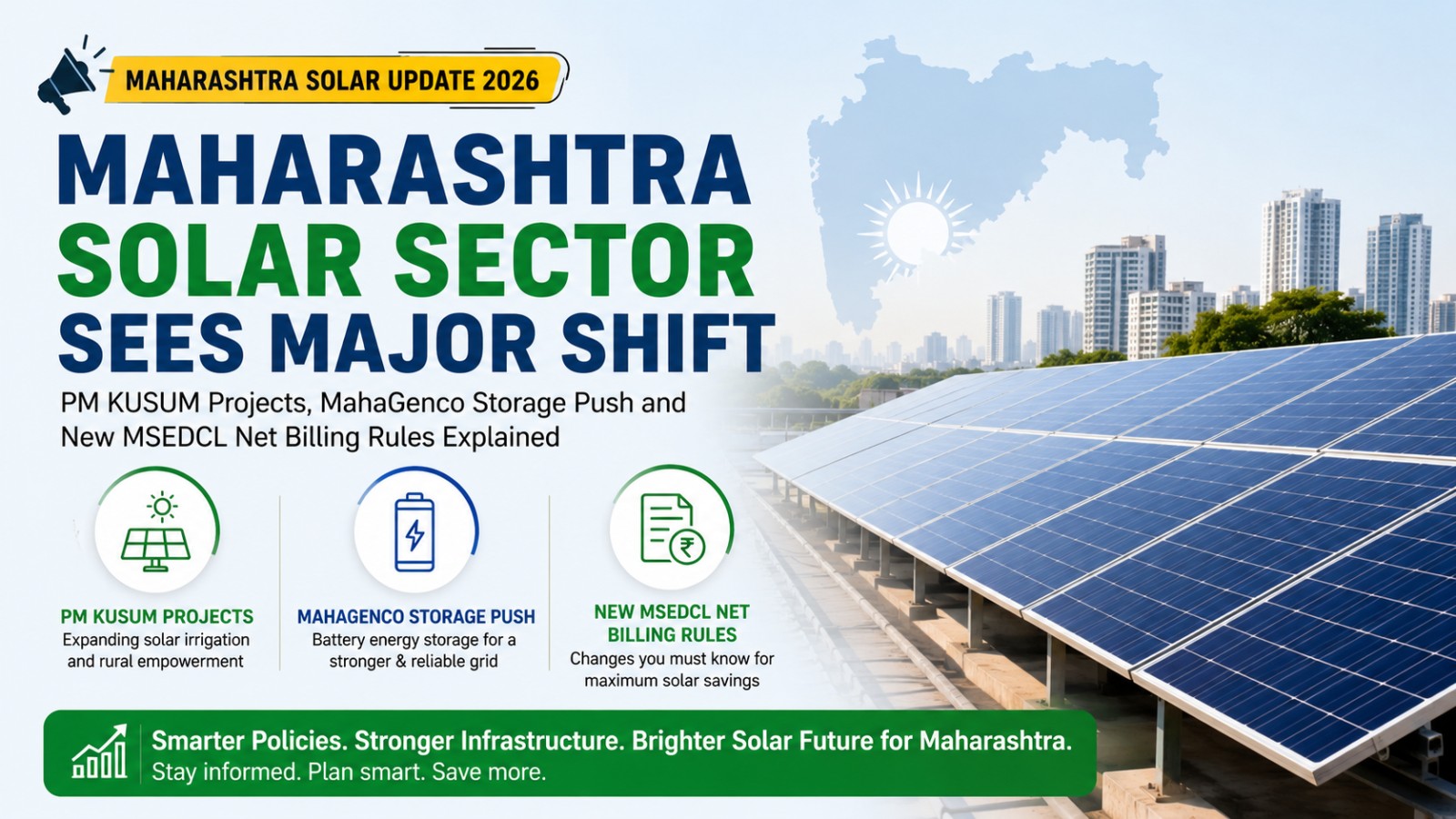
Maharashtra’s renewable energy sector is entering a new phase. Over the past few weeks, multiple developments have signalled that the state’s solar ecosystem is moving beyond simple rooftop installations toward a larger, integrated clean energy network. From the expansion of PM KUSUM agricultural solar projects to MahaGenco’s focus on battery energy storage and MSEDCL’s revised net billing framework, these changes are expected to influence homeowners, businesses, industries and farmers alike.
For anyone planning to install a rooftop solar system, this is more than just another policy update. These decisions could directly impact future electricity savings, project economics and the overall value of solar investments. If you have been waiting for the “right time” to switch to solar, Maharashtra’s latest developments suggest that delaying the decision may not always work in your favour.
Maharashtra Accelerates Its Solar Energy Transition
Maharashtra has consistently remained among India’s leading states for renewable energy adoption. However, the latest policy direction shows a stronger emphasis on balancing electricity generation with grid stability. Instead of focusing only on producing more solar power, the state is now investing in storage infrastructure, agricultural solarisation and updated electricity settlement mechanisms.
This approach aims to reduce dependence on conventional power sources while ensuring consumers continue receiving reliable electricity throughout the day, even after sunset when solar generation naturally declines.
For residential consumers, commercial establishments and MSMEs, this means the state’s electricity ecosystem is gradually becoming more supportive of renewable energy, but also more structured in the way excess solar power is managed.
PM KUSUM Projects Continue to Expand Across Maharashtra
One of the biggest developments is the continued expansion of PM KUSUM projects. The scheme has already transformed how farmers access electricity by promoting decentralised solar power generation.
Instead of depending entirely on conventional grid supply, eligible farmers can install solar-powered irrigation systems and, in many cases, utilise unused land for solar generation. This reduces electricity expenses while creating an additional source of income through surplus power generation wherever applicable under approved schemes.
The expansion of PM KUSUM is expected to improve rural electricity reliability while helping Maharashtra achieve its renewable energy targets.
For agricultural consumers who have not yet explored solar options, early planning could prove beneficial as project allocations, implementation capacity and subsidy opportunities often become more competitive over time.
MahaGenco’s Battery Storage Push Is a Game Changer
Solar energy is available only during daylight hours, making energy storage an essential component of future power systems. Recognising this challenge, MahaGenco has accelerated plans for Battery Energy Storage Systems (BESS).
Battery storage allows excess solar electricity generated during the day to be stored and utilised during evening peak demand. This improves grid reliability and reduces pressure on conventional thermal power stations.
Although battery storage projects mainly strengthen Maharashtra’s power infrastructure today, they also indicate the long-term direction of India’s energy sector. As battery technology becomes more affordable, residential and commercial users may eventually benefit from greater energy independence and improved backup solutions.
This investment demonstrates that Maharashtra is preparing not only for higher solar capacity but also for smarter energy management.
Understanding the New MSEDCL Net Billing Rules
Among all recent developments, the revised MSEDCL net billing framework has generated the most discussion among solar consumers.
Many homeowners are familiar with traditional net metering, where surplus electricity exported to the grid offsets imported electricity. Under net billing, however, exported electricity and imported electricity are calculated separately according to applicable regulations.
This change encourages consumers to maximise their own daytime electricity consumption instead of relying entirely on exporting excess solar power.
For residential users, this makes system sizing even more important. Installing an oversized solar system without analysing your actual consumption pattern may not deliver the expected financial returns under newer billing mechanisms.
Professional load analysis and engineering have therefore become more valuable than ever before.
Why This Matters for Homeowners and Businesses
The recent policy changes highlight one important reality: solar installation is no longer just about buying panels at the lowest price.
Today’s successful solar projects require careful planning, accurate system design, quality components and proper understanding of electricity regulations.
Whether you own an independent house, apartment society, warehouse, factory, hospital, school or commercial building, choosing the correct system capacity has become increasingly important.
An incorrectly designed system may produce excess electricity that offers lower financial value than anticipated, while an undersized system may fail to maximise your monthly savings.
Working with experienced solar professionals ensures your investment is designed around your electricity consumption, future expansion plans and applicable MSEDCL regulations.
Why Waiting Could Become Costlier
Many consumers continue postponing their solar investment while expecting equipment prices to fall further. However, several factors suggest that waiting may not always be the best financial decision.
Electricity tariffs continue to rise gradually every year. Demand for solar installations is increasing rapidly across Maharashtra. Government schemes often evolve, and future policy revisions may alter financial calculations for new applicants.
Installation capacity among experienced EPC companies also becomes limited during periods of high demand, especially before subsidy deadlines or financial year closures.
Every month without solar generally means another month of paying higher electricity bills that could otherwise be significantly reduced.
For families paying ₹2,500 to ₹8,000 in monthly electricity bills or businesses with substantial daytime consumption, even a delay of six to twelve months can represent considerable missed savings.
What Fore Point Solution Recommends
For homeowners and businesses across Palghar, Boisar, Vasai Road, Nalasopara, Virar, Dahanu, Wada and nearby regions, the latest Maharashtra solar developments reinforce one simple message: planning matters more than ever.
Instead of selecting a solar system based only on price, consumers should first understand their electricity usage, roof suitability, subsidy eligibility and expected return on investment.
At Fore Point Solution, every solar project begins with proper engineering assessment rather than guesswork. The team provides complete support including site inspection, customised system design, subsidy guidance, documentation assistance, professional installation and after-sales service.
With changing MSEDCL regulations and evolving state policies, having an experienced solar partner can help ensure your system continues delivering long-term financial benefits instead of unexpected surprises.
The Road Ahead
Maharashtra’s renewable energy journey is clearly accelerating. PM KUSUM expansion, large-scale battery storage initiatives and updated net billing policies all point towards a smarter, cleaner and more resilient electricity ecosystem.
While policy changes may appear complex initially, they ultimately encourage better energy planning and more efficient solar utilisation.
Consumers who understand these developments today will be better positioned to maximise savings over the next 20 to 25 years of their solar system’s lifespan.
The state’s clean energy future is no longer a distant vision. It is already taking shape, and early adopters are likely to benefit the most.
Ready to Benefit From Maharashtra’s Solar Growth?
The solar landscape is changing quickly, and making the right decision today can lead to decades of savings. If you’re planning a rooftop solar system for your home, business or commercial property, Fore Point Solution is here to help.
From free site assessment and engineering consultation to subsidy assistance, MSEDCL documentation, installation and after-sales support, Fore Point Solution delivers end-to-end solar solutions tailored to your energy needs.
Frequently Asked Questions
Q1. What is the latest solar update in Maharashtra?
Maharashtra is expanding PM KUSUM projects, investing in large-scale battery energy storage through MahaGenco and implementing updated MSEDCL net billing regulations that affect rooftop solar consumers.
Q2. What is PM KUSUM?
PM KUSUM is a Government of India scheme that promotes solar-powered agriculture by helping farmers install solar pumps and decentralised solar power systems.
Q3. What is the purpose of MahaGenco’s battery storage projects?
Battery Energy Storage Systems help store excess solar electricity generated during the day and supply it during evening peak demand, improving grid stability and renewable energy utilisation.
Q4. How does the new MSEDCL net billing rule affect rooftop solar owners?
Net billing separately calculates imported and exported electricity, making proper solar system sizing and higher self-consumption more important for achieving maximum financial savings.
Q5. Should I install solar now or wait?
With rising electricity costs, increasing demand and evolving policies, many consumers may benefit by installing a correctly designed solar system sooner rather than delaying and continuing to pay higher electricity bills.
Q6. Can homeowners still get solar subsidies?
Eligible residential consumers can continue to apply under applicable government rooftop solar subsidy schemes, subject to prevailing guidelines and eligibility criteria.
Q7. Why should I choose a professional solar EPC company?
A professional EPC company ensures accurate system design, quality installation, regulatory compliance, documentation support and long-term service, helping maximise your return on investment.


