


Maharashtra’s New 50% Battery Storage Rule: What C&I Solar Projects Above 100 kW Must Know

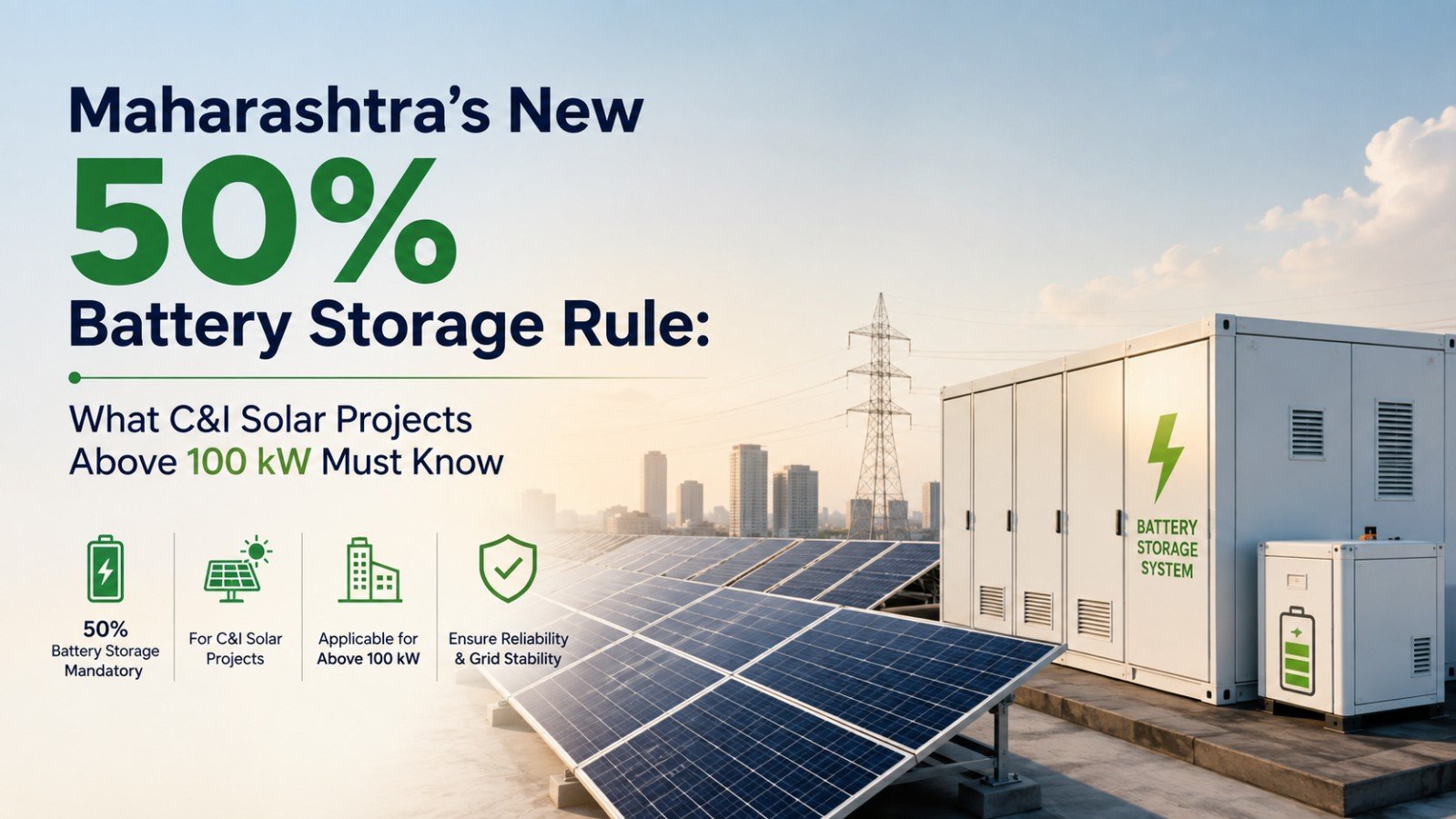
Maharashtra is changing the way new commercial and industrial solar projects will be planned. Under the Maharashtra Renewable Energy and Energy Storage Policy 2025-26 to 2035-36, new renewable energy projects above 100 kW seeking connectivity from April 1, 2026 are required to include a minimum level of energy storage. For solar projects, the initial requirement is storage equivalent to at least 50% of the renewable energy capacity, with a minimum storage duration of two hours. The requirement applies to new projects and is subject to review every two years.
For businesses planning rooftop solar, captive solar or Green Open Access projects, this is more than a technical change. Battery Energy Storage Systems, or BESS, now need to be considered much earlier during project design, budgeting and grid connectivity planning.
Ready to Reduce Your Electricity Bills with Solar?
Find out how much you can save before future policy changes and rising demand increase costs. Get expert guidance on the right solar system and available subsidy benefits.
What Maharashtra’s 50% Battery Storage Rule Means
The policy was approved through a Government Resolution dated March 18, 2026. Its objective is to accelerate renewable energy adoption while improving grid reliability as the share of solar and wind power increases across Maharashtra. The state recorded around 31.3 GW of renewable energy capacity by January 2026, while rooftop solar capacity had reached about 5 GW.
For new rooftop renewable energy projects above 100 kW, the policy states that the minimum storage requirement will initially be 50% of the renewable energy capacity with two hours of storage. Existing rooftop solar installations are not being subjected to this new requirement, although the policy encourages existing projects to add storage where appropriate.
For example, a new 200 kW rooftop solar project would need to plan for a minimum storage capacity equivalent to 100 kW with two hours of duration under the initial requirement. In energy terms, that represents approximately 200 kWh of storage capacity.
The same 50% and two-hour requirement is also specified for new renewable energy projects above 100 kW seeking transmission connectivity under the Open Access framework from April 1, 2026.
Why the Rule Matters to Commercial and Industrial Businesses
Commercial buildings, manufacturing plants, warehouses, hospitals, hotels, educational institutions and industrial facilities are increasingly turning to rooftop solar and Open Access power to reduce electricity costs.
Solar can generate substantial power during daylight hours, but many businesses continue to consume electricity during late afternoon, evening and night-time periods. Energy storage can help shift part of the solar generation to periods when solar output falls.
The Maharashtra policy specifically recognises the importance of storage for reliable renewable energy integration. It also points to the growing demand for renewable electricity among commercial and industrial consumers, including businesses looking for more predictable and time-matched clean power.
For a factory, for instance, a properly designed solar-plus-storage system can potentially reduce dependence on grid electricity during selected operating periods. However, the actual financial benefit will depend on the site’s load profile, tariff structure, solar generation, battery utilisation, demand charges, financing cost and applicable electricity regulations.
The Biggest Change: Solar Planning Can No Longer Be Done in Isolation
Businesses considering a 100 kW-plus solar installation should not evaluate the solar panels alone.
The project design now needs to consider:
1. Solar capacity
The first step remains understanding the facility’s electricity consumption and identifying the appropriate solar capacity. Oversizing or undersizing the plant can affect both project economics and utilisation.
2. Battery capacity and duration
The battery needs to be sized in line with the applicable storage requirement. A 50% storage requirement does not simply mean installing a battery equal to half the solar plant’s annual generation. It refers to storage capacity relative to the renewable energy project capacity, along with the prescribed duration.
3. Electrical infrastructure
The battery, inverter, protection systems, energy management system, transformers, meters and other electrical components need to work together. Space, ventilation, fire safety and operating conditions also need to be assessed during design.
4. Grid connectivity
Connectivity requirements should be considered before procurement and installation. For Open Access projects, the policy specifically links the storage requirement with transmission connectivity for projects above 100 kW.
Will Battery Storage Increase the Cost of a Solar Project?
Yes, adding BESS means a higher initial project investment compared with a solar-only system. But the additional cost should not automatically be viewed as an expense without considering its operational value.
A battery can provide energy shifting, improve renewable energy utilisation and potentially reduce reliance on grid electricity during higher-cost periods. The policy itself notes that storage costs are expected to reduce over time and that adding storage can become increasingly viable as technology develops.
For businesses, the right question is therefore not simply “How much does the battery cost?” It is “What value will the battery provide for this particular facility?”
A proper feasibility study should compare solar generation against the company’s hourly consumption, tariff structure and operating schedule before deciding the battery configuration.
A New Opportunity for Maharashtra’s Industrial Sector
The storage requirement also reflects a broader change in Maharashtra’s electricity market.
The state is encouraging renewable energy through rooftop solar, captive generation and Green Open Access. During FY 2024-25, around 8,400 MU of electricity was wheeled through Open Access in Maharashtra, with just under half coming from renewable sources, according to the state policy. The policy expects renewable participation in Open Access to increase as solar and energy storage become more widely available.
For manufacturing and industrial businesses, this creates an opportunity to rethink energy procurement rather than treating solar as a standalone cost-saving project.
Solar, BESS, captive power and Green Open Access can increasingly be evaluated as parts of a broader energy strategy.
Why Businesses Should Start Planning Early
The biggest risk for a company planning a new solar project is leaving regulatory and technical requirements until the final stage.
A project that has already been designed around solar-only generation may require changes if the applicable connectivity framework requires storage. Reworking the design later can affect equipment selection, electrical layouts, project timelines and financing calculations.
Businesses planning a new rooftop solar or Open Access project above 100 kW should therefore assess the storage requirement at the feasibility stage itself.
This is particularly important for manufacturing units and commercial facilities where electricity demand is continuous or extends beyond normal solar generation hours.
The policy also provides for the storage requirement to be reviewed and updated every two years. This means businesses should keep monitoring future regulatory changes rather than treating the current 50% requirement as a permanent figure.
What C&I Businesses Should Do Now
Companies planning a new solar installation can take a practical approach:
- Review at least 12 months of electricity bills and, wherever possible, hourly load data.
- Determine the right solar capacity based on actual consumption and available roof or project area.
- Assess whether the project falls under the applicable above-100 kW connectivity requirement.
- Include BESS sizing and two-hour duration in the initial project design.
- Evaluate battery economics against the company’s tariff, demand profile and operating hours.
- Check grid connectivity, metering and applicable Open Access requirements.
- Compare the complete project cost rather than comparing solar panel prices alone.
- Select an EPC partner capable of handling solar, storage and associated electrical infrastructure as an integrated project.
Fore Point Solution Can Help Businesses Plan Solar Plus Storage
For industrial, commercial and manufacturing businesses in Maharashtra, the shift towards solar-plus-storage makes professional project planning increasingly important.
Fore Point Solution can help businesses assess their electricity consumption, solar requirements and project feasibility before moving towards implementation. Instead of looking at solar capacity alone, businesses should evaluate the complete energy requirement, including applicable storage, electrical infrastructure and expected savings.
If your business is planning a new rooftop solar project above 100 kW, a solar expansion or a Green Open Access project in Maharashtra, now is a suitable time to review the project design against the new storage framework.
Speak with Fore Point Solution to assess your commercial or industrial solar requirement and identify a suitable solar EPC solution for your facility.
Frequently Asked Questions
Q1. Does the 50% battery storage rule apply to all solar projects in Maharashtra?
No. The policy specifies the minimum storage requirement for new solar and other applicable renewable energy projects above 100 kW seeking connectivity under the relevant rooftop or Open Access frameworks. Projects up to 100 kW fall under a different framework.
Q2. Does the rule apply to existing rooftop solar systems?
The policy states that existing rooftop solar projects are allowed and encouraged to add energy storage, but the new mandatory minimum storage requirement applies to new projects.
Q3. How much battery storage is required for a 200 kW solar plant?
Under the initial 50% requirement, a 200 kW renewable energy project would require storage equivalent to 100 kW with a two-hour duration. That corresponds to approximately 200 kWh of energy storage.
Q4. Does the requirement apply to Green Open Access projects?
Yes. The policy specifies a minimum storage requirement for new renewable energy projects above 100 kW seeking transmission connectivity under the Distribution and Transmission Open Access Regulations from April 1, 2026, initially at 50% of renewable capacity with two-hour duration.
Q5. Will the 50% storage requirement remain unchanged?
Not necessarily. The policy states that the minimum storage requirement will be reviewed and updated every two years.
Q6. Can battery storage improve the financial performance of a solar project?
It can, depending on the project’s load profile and tariff structure. Storage may allow solar energy to be used during periods when the facility would otherwise draw more electricity from the grid. The actual savings must be calculated through a project-specific feasibility study.
Q7. Should businesses wait before installing solar?
Businesses should not delay a project simply because storage is now part of the planning process. Instead, they should assess the complete solar-plus-storage requirement before finalising project capacity, equipment and financing. Early planning can help avoid redesigns and provide a clearer picture of the project’s long-term economics.


