


MERC Approves ₹960 Crore Rooftop Solar Scheme for 2.11 Lakh Maharashtra Households

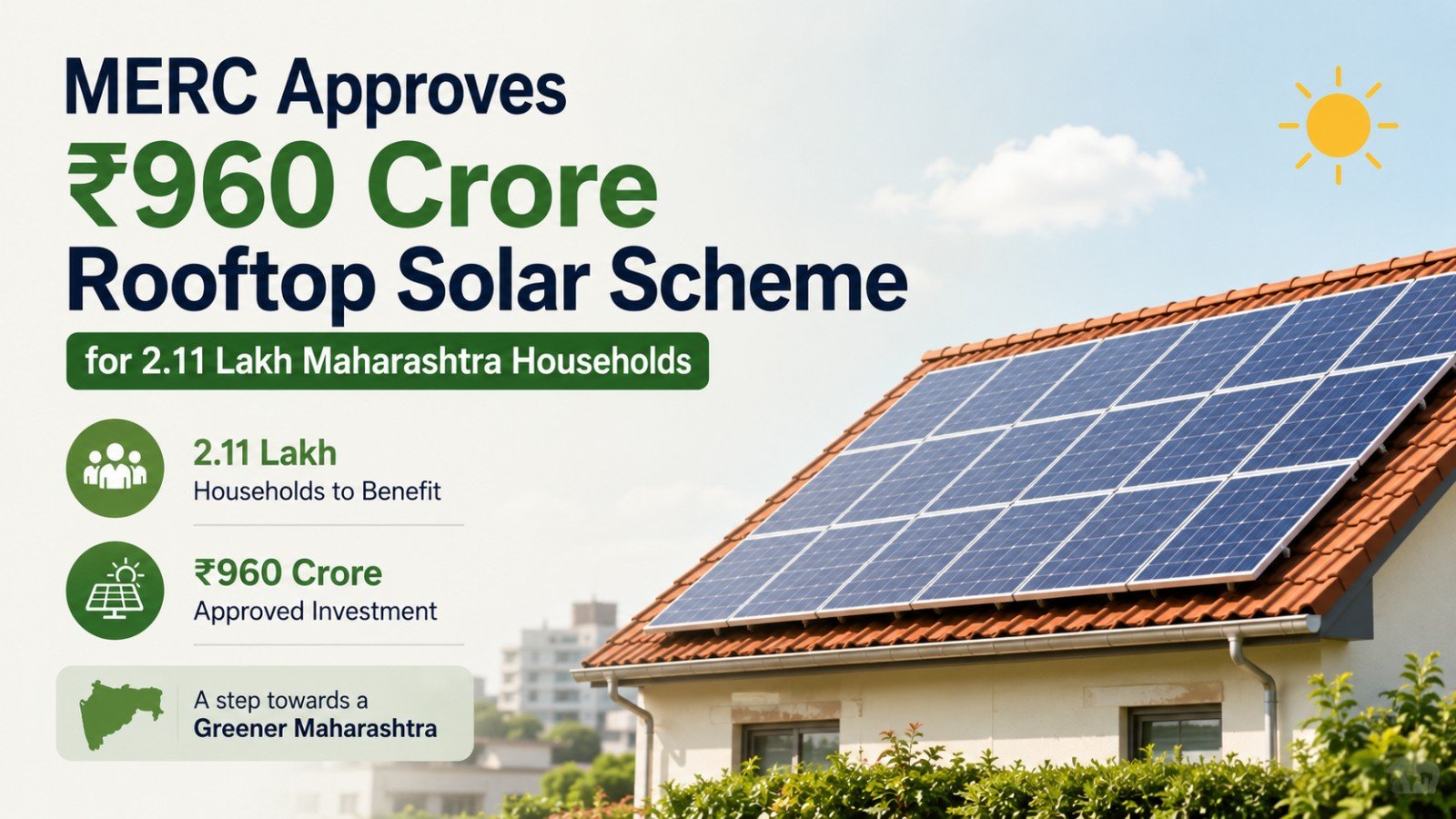
The Maharashtra rooftop solar market has received another major policy push. The Maharashtra Electricity Regulatory Commission (MERC) has approved Maharashtra State Electricity Distribution Company Limited’s proposal to implement a Utility Led Aggregation model for 2,11,206 low income households under the PM Surya Ghar: Muft Bijli Yojana and Maharashtra’s Swayampurna Maharashtra Aawasiya Rooftop Solar (SMART) Scheme. MERC’s hearing records show that MSEDCL sought approval for the programme in August 2026.
The project is valued at approximately ₹959.93 crore, commonly rounded to ₹960 crore, and will support the installation of 1 kWp rooftop solar systems for eligible EWS and BPL households consuming less than 100 units of electricity per month. The systems are designed to provide up to 100 units of electricity each month, reducing electricity expenses for participating households.
While the approved programme is focused on low income residential consumers, its importance extends beyond the immediate beneficiaries. It is another indication that rooftop solar is becoming a mainstream part of Maharashtra’s electricity strategy. For housing societies, commercial establishments, factories, manufacturers and other businesses, the broader trend is worth watching closely.
Ready to Reduce Your Electricity Bills with Solar?
Find out how much you can save before future policy changes and rising demand increase costs. Get expert guidance on the right solar system and available subsidy benefits.
What the ₹960 Crore Maharashtra Rooftop Solar Scheme Means
The approved programme brings together two major initiatives: the central PM Surya Ghar: Muft Bijli Yojana and Maharashtra’s SMART scheme. Through the Utility Led Aggregation model, MSEDCL can coordinate rooftop solar deployment at a large scale instead of relying only on individual household adoption.
The scale is significant. More than two lakh households are included in one programme, representing a potential rooftop solar capacity of roughly 211 MW. The initiative also aims to reduce the financial burden associated with electricity subsidies while improving access to distributed renewable energy.
This is important for Maharashtra’s wider solar ecosystem because large programmes create demand for EPC services, installation expertise, electrical equipment, operations and maintenance, monitoring and project management.
Subsidy For Rooftop Solar: Who Can Benefit?
For residential consumers, the Subsidy For rooftop Solar remains one of the strongest drivers of adoption under PM Surya Ghar. The central scheme provides financial assistance for residential rooftop solar systems, with higher support for the first 2 kW and additional support for the next 1 kW. Systems above 3 kW do not receive additional central financial assistance beyond the applicable maximum.
The programme also provides support for Group Housing Societies and Residential Welfare Associations for common facilities, including EV charging, subject to the scheme’s capacity limits and eligibility conditions. This makes the topic particularly relevant to housing societies planning solar for common electricity consumption.
However, subsidy eligibility should not be confused with the ₹960 crore Maharashtra programme. The newly approved ULA project is a specific MSEDCL initiative for eligible low income households. Other residential consumers, societies and businesses need to evaluate their own eligibility under the applicable central and state provisions.
Solar Subsidy for Housing Societies in Maharashtra
Housing societies are increasingly looking at rooftop solar because common area electricity consumption can represent a substantial recurring expense. Lifts, water pumps, lighting, security systems and other shared facilities can create a consistent daytime electricity load.
The availability of solar subsidy for housing societies in Maharashtra can improve project economics where the society and proposed installation meet the applicable PM Surya Ghar requirements. The central guidelines specifically recognise Group Housing Societies and RWAs for common facilities, including EV charging.
For a society considering solar, the practical approach is to first assess its sanctioned load, monthly electricity consumption, available roof area, daytime demand and metering arrangement. A properly sized system can then be evaluated against the expected generation, project cost and applicable financial assistance.
Why This Matters to Maharashtra Businesses
The residential sector is only one part of the larger rooftop solar opportunity. Maharashtra has a substantial base of manufacturing units, warehouses, offices, commercial buildings and industrial facilities where electricity is a major operating cost.
For these businesses, the main benefit is generally not residential subsidy. Instead, the business case is built around reducing grid electricity purchases, improving long term energy cost visibility and making productive use of available rooftop space.
A manufacturing facility with significant daytime electricity consumption can be particularly well suited to rooftop solar because solar generation occurs during the same period when machinery, HVAC systems, pumps and other equipment may be operating.
Commercial and industrial consumers can therefore evaluate solar through metrics such as annual electricity consumption, tariff structure, rooftop capacity, generation potential, project cost, financing method and expected payback.
MSEDCL already maintains procedures and documentation for rooftop renewable energy connectivity and net metering, including provisions covering solar PV projects below 1 MW under the applicable regulatory framework.
The Rooftop Solar Market Is Moving Fast
The latest national numbers reinforce the direction of the market. India added 2.7 GW of rooftop solar capacity in Q1 2026, compared with 2.2 GW in Q4 2025 and 1.2 GW in Q1 2025. Residential installations accounted for 82% of quarterly additions, while industrial and commercial consumers contributed 11% and 7%, respectively. Maharashtra was among the leading states for rooftop solar capacity additions.
The government also reported in August 2026 that PM Surya Ghar had crossed 50 lakh rooftop solar installations, with 14.8 GW of rooftop solar capacity commissioned under the programme.
For businesses, this growing market creates a practical reason to start planning rather than waiting until electricity costs or project demand force a rushed decision. EPC capacity, project assessment, approvals, equipment selection and installation planning all require time.
What Businesses Should Assess Before Installing Solar
A commercial or industrial solar project should begin with an energy assessment rather than simply selecting a system size.
Businesses should review their previous 12 months of electricity bills, sanctioned load, maximum demand, daytime consumption pattern, tariff components and available roof area. The structural condition of the roof should also be assessed before installation.
The next step is to estimate annual solar generation and compare it with the facility’s actual consumption. This helps determine whether a rooftop system should be designed primarily around self consumption, export opportunities or a combination of both.
Businesses should also compare EPC proposals carefully. Module quality, inverter selection, mounting structures, protection systems, monitoring, warranties, workmanship and after sales service can influence the long term performance of a project.
Why Delaying a Solar Assessment Could Be Costly
The strongest reason to act now is not fear of missing a subsidy. It is the growing shift toward distributed energy across Maharashtra.
As more households, societies and businesses adopt rooftop solar, companies that have suitable rooftops and substantial electricity consumption have an opportunity to evaluate their energy costs before making future investment decisions. Waiting does not automatically make solar more expensive, but it can postpone potential savings and delay the benefits of generating electricity on site.
The latest MERC approval is another signal that rooftop solar is moving deeper into Maharashtra’s electricity infrastructure. Businesses that have not yet assessed their solar potential can use this period to understand their numbers and determine whether a project makes financial sense.
How Fore Point Solution Can Help
For industrial, commercial and manufacturing businesses in Maharashtra, Fore Point Solution provides solar EPC services covering project assessment, system design, installation and related solar requirements.
Instead of choosing a system based only on roof size, businesses can evaluate solar according to actual electricity consumption and operational requirements. A detailed assessment can help identify the suitable system capacity, expected generation, project economics and implementation requirements.
If your factory, warehouse, office, commercial building or business facility has a suitable rooftop and significant electricity consumption, now is a practical time to assess its solar potential.
Follow the Fore Point Solution News for latest Maharashtra solar policy, subsidy and rooftop solar developments with Fore Point Solution, and speak with the team about suitable solar EPC solutions for your business.
Frequently Asked Questions
Q1. What is the ₹960 crore rooftop solar scheme in Maharashtra?
It is a ₹959.93 crore MSEDCL programme approved by MERC for implementing the Utility Led Aggregation model for 2,11,206 eligible low income households across Maharashtra under PM Surya Ghar and the state SMART scheme.
Q2. Who is eligible under the newly approved Maharashtra programme?
The programme targets eligible BPL and EWS households with electricity consumption below 100 units per month. Eligible households are planned to receive 1 kWp rooftop solar systems.
Q3. What is the Subsidy For rooftop Solar under PM Surya Ghar?
PM Surya Ghar provides central financial assistance for eligible residential rooftop solar installations. The scheme provides support for the first 2 kW and additional support for the next 1 kW, subject to the applicable benchmark costs and scheme conditions.
Q4. Is there solar subsidy for housing societies in Maharashtra?
Yes. PM Surya Ghar guidelines provide for financial assistance to eligible Group Housing Societies and RWAs for common facilities, including EV charging, within specified capacity limits and conditions.
Q5. Can factories and manufacturing companies claim the same residential rooftop subsidy?
Residential central financial assistance under PM Surya Ghar should not be assumed to apply to industrial or commercial installations. Businesses should evaluate the applicable regulatory, tariff, financing and project economics for their specific facility.
Q6. Is rooftop solar suitable for manufacturing businesses?
It can be particularly attractive for facilities with substantial daytime electricity consumption because solar generation can directly offset electricity purchased from the grid. The actual benefit depends on the facility’s load profile, tariff, roof area, system size and applicable regulations.
Q7. Should a Maharashtra business wait before installing rooftop solar?
Businesses should not make the decision based on headlines alone. A proper assessment of electricity consumption, rooftop suitability, project cost, expected generation and applicable regulations can show whether installing solar now makes financial sense. With rooftop solar adoption accelerating across India, conducting the assessment early can help businesses make a better informed investment decision.


