


Maharashtra Opens Green Open Access to 100 kW Consumers, Bringing Off Site Solar Within Reach of MSMEs

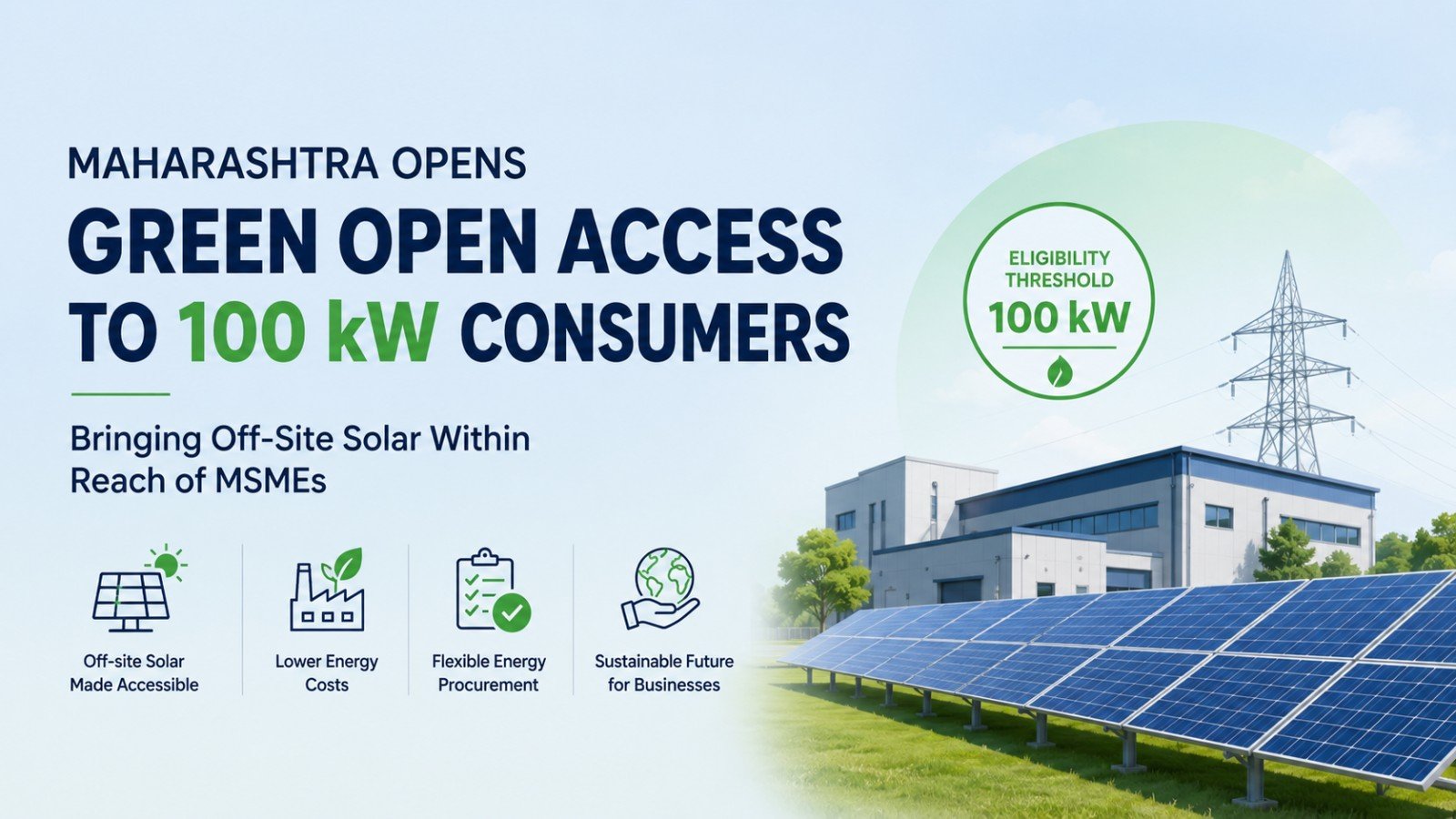
Maharashtra’s renewable energy market is opening up to a much wider group of businesses. Under the state’s renewable energy policy, the eligibility threshold for Green Energy Open Access has been brought down from the earlier 1 MW level to 100 kW, giving more commercial and industrial electricity consumers the opportunity to source renewable power through open access.
For Maharashtra’s MSMEs, manufacturing units, commercial establishments and other businesses with electricity demand around this level, the change could make off-site solar a much more practical option. Instead of depending entirely on a rooftop installation, eligible businesses can explore procuring renewable electricity from solar projects located away from their premises, subject to the applicable open-access rules, charges and technical requirements.
The change is significant because many businesses simply do not have enough usable roof area to install a solar system large enough to meaningfully offset their electricity consumption. Green Open Access creates another route: use renewable generation elsewhere and receive the associated power through the electricity network.
Ready to Reduce Your Electricity Bills with Solar?
Find out how much you can save before future policy changes and rising demand increase costs. Get expert guidance on the right solar system and available subsidy benefits.
What Has Changed for Businesses in Maharashtra?
The move to a 100 kW eligibility threshold is not entirely new from a regulatory perspective. Maharashtra Electricity Regulatory Commission (MERC) regulations had already incorporated eligibility for consumers with a contract demand or sanctioned load of 100 kW or more. MSEDCL subsequently issued guidelines for implementing Green Energy Open Access in September 2024.
Maharashtra’s Renewable Energy and Energy Storage Policy 2025–26 to 2035–36 now places this lower threshold within a broader state strategy aimed at making renewable energy access easier, particularly for MSMEs. The policy specifically identifies the reduction from 1 MW to 100 kW as a way to expand competitive electricity procurement to a wider consumer base.
In practical terms, a business with a sanctioned load or contract demand of 100 kW or more may now have an opportunity to investigate Green Energy Open Access rather than treating renewable electricity as an option available only to very large industrial consumers.
Why the 100 kW Threshold Matters
The biggest change is the size of the potential customer base.
Large factories and major industrial facilities have historically had more options when it comes to renewable power procurement. Smaller manufacturing plants, warehouses, commercial complexes and MSMEs often faced a different situation. Their electricity consumption could be substantial, but not necessarily large enough to make traditional open-access procurement straightforward.
At 100 kW, the conversation becomes relevant to a much broader section of Maharashtra’s business economy.
Consider a manufacturing facility operating machinery for several hours every day. Electricity is a recurring operating expense, not a one-time purchase. Even a modest reduction in the effective cost of power, when sustained over several years, can have a meaningful impact on operating economics.
The exact saving, however, cannot be assumed simply from the 100 kW eligibility figure. Businesses need to evaluate their actual consumption profile, tariff category, renewable energy procurement structure, open-access charges, transmission and wheeling costs, applicable surcharges, banking provisions and other regulatory conditions before deciding whether the model makes financial sense.
That assessment is where the opportunity becomes more interesting than the headline.
Off-Site Solar Solves a Major Rooftop Limitation
Rooftop solar remains an attractive solution for businesses with suitable roofs. But not every industrial or commercial property has enough usable space.
A factory may have high electricity consumption but a relatively small roof. A commercial complex may have multiple tenants competing for common rooftop space. A manufacturing facility may also face structural, shading, expansion or operational constraints.
Off-site solar can potentially address this mismatch.
Instead of asking, “How many panels can I fit on my building?”, a business can begin asking, “How much renewable electricity does my business actually need, and what is the most economical way to procure it?”
That shift is particularly relevant for energy-intensive MSMEs.
Maharashtra’s existing framework also allows eligible consumers to source renewable energy through open access, while the state’s official procedures identify MSLDC and the State Transmission Utility as nodal agencies for different categories of open access.
Where the Business Impact Could Be Felt
For industrial and commercial electricity consumers, the attraction of renewable power goes beyond the monthly electricity bill.
1. Lower exposure to conventional power costs
Electricity is a major recurring cost for many businesses. Renewable procurement can provide an alternative source of power and potentially improve long-term energy-cost planning.
The actual financial benefit depends on the complete commercial structure, so businesses should compare the expected renewable energy cost against their existing electricity cost after accounting for applicable open-access charges.
2. Better control over energy planning
Businesses increasingly want greater visibility into their future energy expenses. A structured renewable procurement strategy can become part of a longer-term energy plan rather than being treated simply as a sustainability initiative.
3. Sustainability credentials
Manufacturers and suppliers are increasingly operating within supply chains where customers, investors and corporate buyers pay closer attention to environmental performance. Increasing renewable electricity consumption can support a company’s broader sustainability objectives.
4. Flexibility beyond rooftop capacity
Perhaps the most practical benefit is flexibility. Businesses that cannot install enough rooftop solar may still be able to investigate renewable procurement through an off-site arrangement.
The Solar Market Is Moving Beyond Rooftops
India’s commercial and industrial solar market is becoming more diverse. Businesses are looking at rooftop systems, open access, captive and group-captive structures, renewable power purchase arrangements and combinations of these models.
The national Green Energy Open Access Rules had already reduced the minimum transaction threshold for green energy open access from 1 MW to 100 kW, with the stated objective of enabling smaller consumers to purchase renewable energy through open access.
Maharashtra’s policy direction adds momentum at the state level.
For business owners, this means solar planning is increasingly becoming an energy-procurement decision rather than simply an equipment purchase.
What Should a 100 kW+ Business Do Next?
The first step should not be signing a solar agreement. It should be understanding the business’s electricity profile.
Start by reviewing the last 12 months of electricity bills. Look at sanctioned load, contract demand, monthly consumption, maximum demand, operating hours and the pattern of daytime versus nighttime consumption.
Then assess whether rooftop solar can meet a meaningful portion of the requirement. If roof space is inadequate, Green Energy Open Access may deserve consideration.
Businesses should also compare different procurement structures rather than assuming that one solar model will automatically be the cheapest.
This is especially important because open access involves more than the generation tariff. Transmission, wheeling, banking, cross-subsidy and other applicable charges and conditions can influence the final economics. The national Green Energy Open Access framework itself recognises multiple categories of charges and conditions.
Why Businesses Should Not Wait Too Long
The 100 kW threshold does not mean every eligible business will automatically save money by switching to off-site solar.
What it does mean is that a significantly larger number of businesses can now evaluate the option.
That distinction matters.
Energy costs are an ongoing business consideration, and renewable procurement projects can require planning, feasibility assessment, approvals, commercial negotiations and implementation. Businesses that begin evaluating their options early have more time to compare rooftop, open-access and other models instead of making decisions under pressure.
For MSMEs and manufacturers competing on tight operating margins, even a small improvement in energy economics can deserve serious attention.
The opportunity is therefore less about rushing into solar and more about avoiding unnecessary delay in understanding what is available.
How Fore Point Solution Can Help
For industrial, manufacturing and commercial businesses in Maharashtra, the right solar solution depends on the facility’s electricity consumption, available space, operating pattern and financial objectives.
Fore Point Solution helps businesses assess their solar requirements and explore suitable EPC solutions based on their specific energy needs. Whether the requirement is for a commercial rooftop installation or a broader renewable energy strategy, a proper assessment can help identify the practical route before making an investment.
Businesses can visit Fore Point Solution to understand the available solar solutions and enquire about an assessment for their facility.
For Maharashtra businesses, the important message is simple:
100 kW is no longer a size at which renewable power procurement needs to be dismissed as an option for only very large companies. The regulatory environment is creating more room for MSMEs and mid-sized commercial and industrial consumers to investigate renewable electricity as part of their long-term energy strategy.
The next step is not to assume that off-site solar is automatically the answer. It is to run the numbers, understand the applicable charges, compare the available models and determine whether renewable procurement fits the business.
For companies that have been waiting for solar to become more accessible, this is a good time to start that assessment.
Frequently Asked Questions
Q1. What is Green Energy Open Access?
Green Energy Open Access allows eligible electricity consumers to procure renewable electricity through the power network from renewable energy generators, subject to applicable regulations and charges.
Q2. What is the Green Open Access threshold in Maharashtra?
The applicable eligibility threshold for consumers is 100 kW of contract demand or sanctioned load, subject to the relevant regulations and conditions. Maharashtra’s renewable energy policy explicitly highlights the reduction from the earlier 1 MW level to 100 kW.
Q3. Does a 100 kW business automatically qualify for cheaper electricity?
No. Eligibility to use Green Energy Open Access does not guarantee a particular level of savings. The economics depend on the renewable energy tariff and applicable transmission, wheeling, banking, surcharge and other charges.
Q4. Can an MSME use off-site solar if it does not have enough rooftop space?
Potentially, yes. Green Energy Open Access creates a pathway for eligible consumers to procure renewable power from generation projects away from their premises, subject to the applicable regulatory and technical requirements.
Q5. Is rooftop solar still useful?
Absolutely. Rooftop solar can remain an effective option where adequate roof area and suitable technical conditions exist. For some businesses, a combination of rooftop generation and renewable power procurement may also be worth evaluating.
Q6. What should a business check before choosing open-access solar?
Review electricity bills, sanctioned load, contract demand, consumption patterns, tariff category, available rooftop area and operating hours. Then compare the complete cost of different solar procurement options, including applicable open-access charges.
Q7. Who should consider evaluating this opportunity?
Manufacturing units, industrial facilities, commercial complexes, warehouses and other businesses with electricity demand of 100 kW or more may find it worthwhile to assess their Green Energy Open Access options.


