


MERC Clears ₹959.93 Crore Rooftop Solar Plan for 2.11 Lakh Maharashtra Households, Up to 100 Free Units Monthly

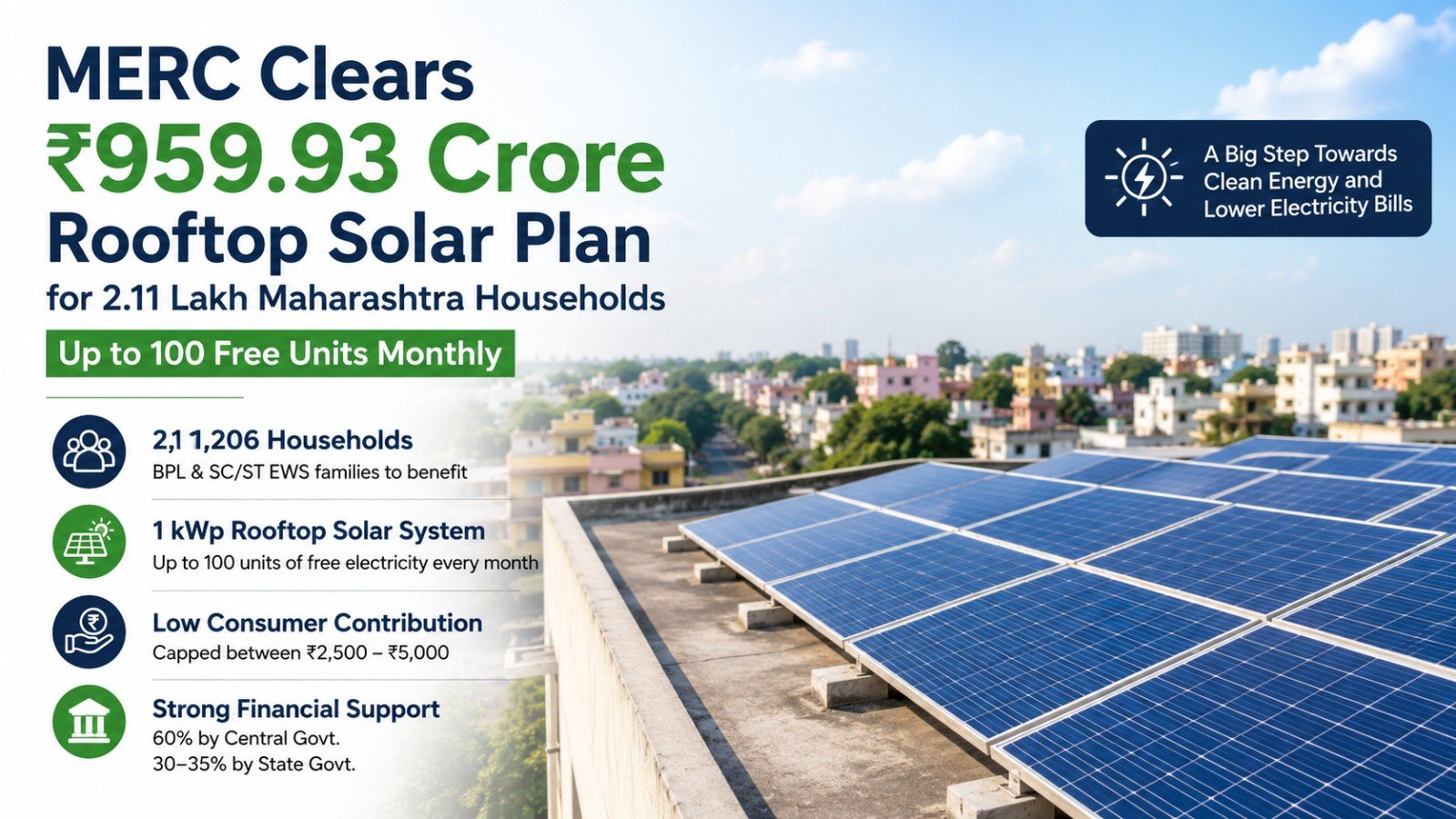
Maharashtra is set to take another significant step towards expanding rooftop solar among economically weaker households. The Maharashtra Electricity Regulatory Commission (MERC) has cleared a ₹959.93 crore plan proposed by the Maharashtra State Electricity Distribution Company Limited (MSEDCL) to solarise 2,11,206 low income households across the state.
The programme is being implemented through a Utility Led Aggregation (ULA) model that brings together the central PM Surya Ghar: Muft Bijli Yojana and Maharashtra’s State SMART scheme. Under the plan, eligible households will receive 1 kWp rooftop solar systems, with the installations designed to provide up to 100 units of electricity every month.
The proposal is notable because it shifts rooftop solar adoption from an individual household decision towards a large scale, utility coordinated programme. MERC’s public hearing records confirm that MSEDCL filed Case No. 184 of 2026 seeking approval for the ULA model covering 2,11,206 low income households under PM Surya Ghar and the State SMART scheme.
Ready to Reduce Your Electricity Bills with Solar?
Find out how much you can save before future policy changes and rising demand increase costs. Get expert guidance on the right solar system and available subsidy benefits.
What the Maharashtra Rooftop Solar Plan Means for Households
The central objective of the programme is to reduce the electricity burden on eligible BPL and SC/ST economically weaker households while increasing the use of distributed renewable energy.
Each selected household is expected to receive a 1 kWp rooftop solar system. Based on the programme structure, households can receive up to 100 free electricity units each month from the solar generation.
For families that regularly consume electricity within or around this range, rooftop solar can substantially reduce their dependence on grid supplied power. The benefit is particularly important for households where electricity expenditure represents a meaningful share of monthly income.
The programme also limits the amount that participating consumers have to contribute. The proposed consumer contribution is capped in the range of ₹2,500 to ₹5,000, with the remaining project cost supported through central and state financial assistance.
This funding structure is intended to make rooftop solar accessible to households that may otherwise find the initial installation cost difficult to manage.
₹959.93 Crore Investment and the ULA Model
The scale of the initiative is one of its most important features.
Instead of treating more than two lakh rooftop systems as separate individual projects, the ULA model allows MSEDCL to aggregate demand and coordinate implementation at scale. This can help streamline procurement, installation, monitoring and other project processes.
The approach also demonstrates how rooftop solar is increasingly being treated as part of Maharashtra’s wider electricity infrastructure rather than simply as a consumer product.
MERC’s records show that the Commission has been actively dealing with rooftop renewable energy regulations and related mechanisms. Maharashtra’s current renewable energy framework includes the MERC Grid Interactive Rooftop Renewable Energy Generating Systems Regulations and their 2024 amendment.
For households, the immediate benefit is lower electricity expenditure. For the state, the wider objective is to increase distributed solar capacity while reducing the pressure associated with conventional electricity supply.
How the Free Electricity Benefit Can Work
The phrase “up to 100 free units” is important.
It does not mean that every household will automatically receive exactly 100 units regardless of its consumption or solar generation. The actual benefit depends on the electricity generated by the rooftop system and the household’s consumption pattern.
A 1 kWp solar installation can generate electricity during daylight hours, with actual generation varying according to factors such as sunlight, weather, system performance, shading and rooftop conditions.
This makes proper installation and system maintenance important. A rooftop solar plant is a long term energy asset, and its performance depends not only on installed capacity but also on engineering, installation quality and regular monitoring.
Why This Matters Beyond Residential Solar
Although the new programme is focused on low income households, its significance extends well beyond the residential segment.
Maharashtra is already seeing greater regulatory and investment activity across rooftop solar, utility scale renewable energy, open access and distributed generation. MERC’s current regulatory framework includes rooftop solar provisions, while the Commission’s hearing schedule also shows continued activity around solar procurement, distributed solar and renewable energy projects.
This wider movement matters to industrial, commercial and manufacturing businesses because electricity is often a major operating expense.
A factory, warehouse, hotel, hospital, commercial building or manufacturing unit generally has a much higher electricity requirement than a residential consumer. For these businesses, a properly sized rooftop solar plant can offset a significant portion of daytime electricity consumption.
The economics can become particularly relevant for businesses with large daytime loads, because solar generation coincides with operating hours in many commercial and industrial facilities.
Solar Is Becoming a Business Cost Strategy
For Maharashtra businesses, rooftop solar should increasingly be evaluated as an energy cost management decision rather than simply an environmental initiative.
Electricity tariffs, demand charges, operating costs and long term energy requirements all affect business profitability. Solar can provide greater control over a portion of electricity costs by generating power on site.
The potential benefits include reduced grid electricity consumption, improved long term energy cost visibility and stronger sustainability credentials.
For manufacturing businesses, the opportunity can be even more significant because electricity consumption can remain substantial throughout production hours. Warehouses and commercial facilities with large roof areas may also have an opportunity to convert unused rooftop space into productive energy infrastructure.
However, the right system size cannot be decided simply by looking at available roof area. Electricity bills, sanctioned load, consumption patterns, roof condition, shadow analysis, system configuration and applicable regulations all need to be considered before investment.
Why Businesses Should Not Wait Too Long
The rapid expansion of solar programmes in Maharashtra is creating a stronger ecosystem around rooftop generation, engineering, installation and renewable energy financing.
For business owners, delaying a solar assessment does not necessarily mean that an immediate opportunity will disappear. However, it can mean continuing to pay the full cost of grid electricity while competitors and other businesses evaluate ways to reduce their energy expenditure.
A solar project also requires planning. Large installations may involve structural assessment, electrical design, approvals, equipment procurement, installation and commissioning. Businesses that start the evaluation process early have more time to compare system configurations and understand the financial outcome before making a capital decision.
This is particularly relevant for manufacturing units and commercial properties planning expansion. A solar assessment completed before a major facility upgrade can help integrate rooftop generation into the broader electrical design instead of treating it as an afterthought.
What Maharashtra Businesses Should Check Before Installing Solar
Businesses considering rooftop solar should begin with their electricity consumption rather than a fixed system size.
The first step is to review recent electricity bills and identify annual consumption, daytime usage, sanctioned load and demand patterns. The available rooftop area should then be assessed for structural suitability and solar exposure.
A professional feasibility study should also consider expected generation, system losses, equipment specifications, payback period, financing requirements and applicable electricity regulations.
For industrial and commercial consumers, the choice between rooftop solar, open access, captive generation or other renewable energy arrangements may depend on the size and nature of the operation.
This is where an experienced solar EPC partner can add value by evaluating the complete requirement instead of simply recommending a standard capacity.
What This Trend Means for the Solar Market
The Maharashtra programme sends a broader signal about the direction of the state’s energy market.
A project covering more than two lakh households demonstrates the potential for distributed solar to operate at very large scale. At the same time, Maharashtra continues to develop renewable energy procurement and rooftop solar regulations.
For solar EPC companies, this creates opportunities across residential, commercial and industrial segments. For consumers, it also makes technical due diligence more important because the quality of engineering, installation and after sales support can influence long term system performance.
Businesses should therefore compare EPC providers based on technical capability, project execution, documentation, equipment quality, service support and the ability to design a system around actual electricity consumption.
Fore Point Solution: Assess Your Solar Opportunity
For Maharashtra businesses looking to reduce electricity costs, the next practical step is to understand how much solar their facility can realistically support.
Fore Point Solution provides solar EPC solutions for businesses evaluating rooftop solar installations. Industrial units, manufacturing facilities, commercial properties and other high electricity consumers can assess their electricity usage, available roof area and potential solar requirements before making an investment decision.
If your business operates in Maharashtra and you are considering rooftop solar, now is a suitable time to start with an engineering and financial assessment rather than waiting until electricity costs become a larger operating burden.
Want more updates on Maharashtra’s solar and renewable energy sector? Follow the latest Fore Point Solution News for developments involving rooftop solar, government schemes, electricity regulations, industrial solar and renewable energy opportunities in Maharashtra.
Final Takeaway
MERC’s clearance of the ₹959.93 crore rooftop solar initiative marks a major development in Maharashtra’s distributed energy transition. With 2,11,206 low income households targeted through the ULA model, the programme demonstrates how rooftop solar can be deployed at scale while reducing the electricity burden on eligible consumers.
For Maharashtra’s industrial, commercial and manufacturing sector, the larger message is equally important: solar is becoming an increasingly practical component of energy cost planning. Businesses that evaluate their electricity consumption and solar potential early can make better informed decisions about where renewable energy fits into their long term operating strategy.
Frequently Asked Questions
Q1. How many households are covered under the Maharashtra rooftop solar plan?
The programme covers 2,11,206 low income households under the Utility Led Aggregation model proposed by MSEDCL. MERC’s hearing records identify the programme under Case No. 184 of 2026.
Q2. What size solar system will eligible households receive?
The programme is based on 1 kWp rooftop solar systems for the targeted households.
Q3. How many free electricity units can households receive?
The rooftop systems are designed to provide up to 100 units of electricity per month, subject to actual solar generation and household consumption.
Q4. How much will households have to contribute?
The consumer contribution is proposed to be capped between ₹2,500 and ₹5,000, with the balance supported through central and state financial assistance under the programme structure.
Q5. Which schemes are being combined for this programme?
The initiative combines the PM Surya Ghar: Muft Bijli Yojana with Maharashtra’s State SMART scheme through the Utility Led Aggregation model.
Q6. Does this rooftop solar programme apply to factories and commercial businesses?
The specific programme discussed here targets eligible low income households. However, its scale reflects the broader growth of rooftop and distributed solar in Maharashtra. Businesses have separate solar options that should be evaluated according to their electricity consumption, roof area, load profile and applicable regulations.
Q7. How can a Maharashtra business determine the right solar capacity?
Businesses should begin with recent electricity bills, annual consumption, daytime load, sanctioned load and available roof area. A professional solar EPC feasibility assessment can then determine an appropriate system size, expected generation and potential financial savings.


