


Maharashtra Crosses 4.66 Lakh Rooftop Solar Installations Under National Scheme

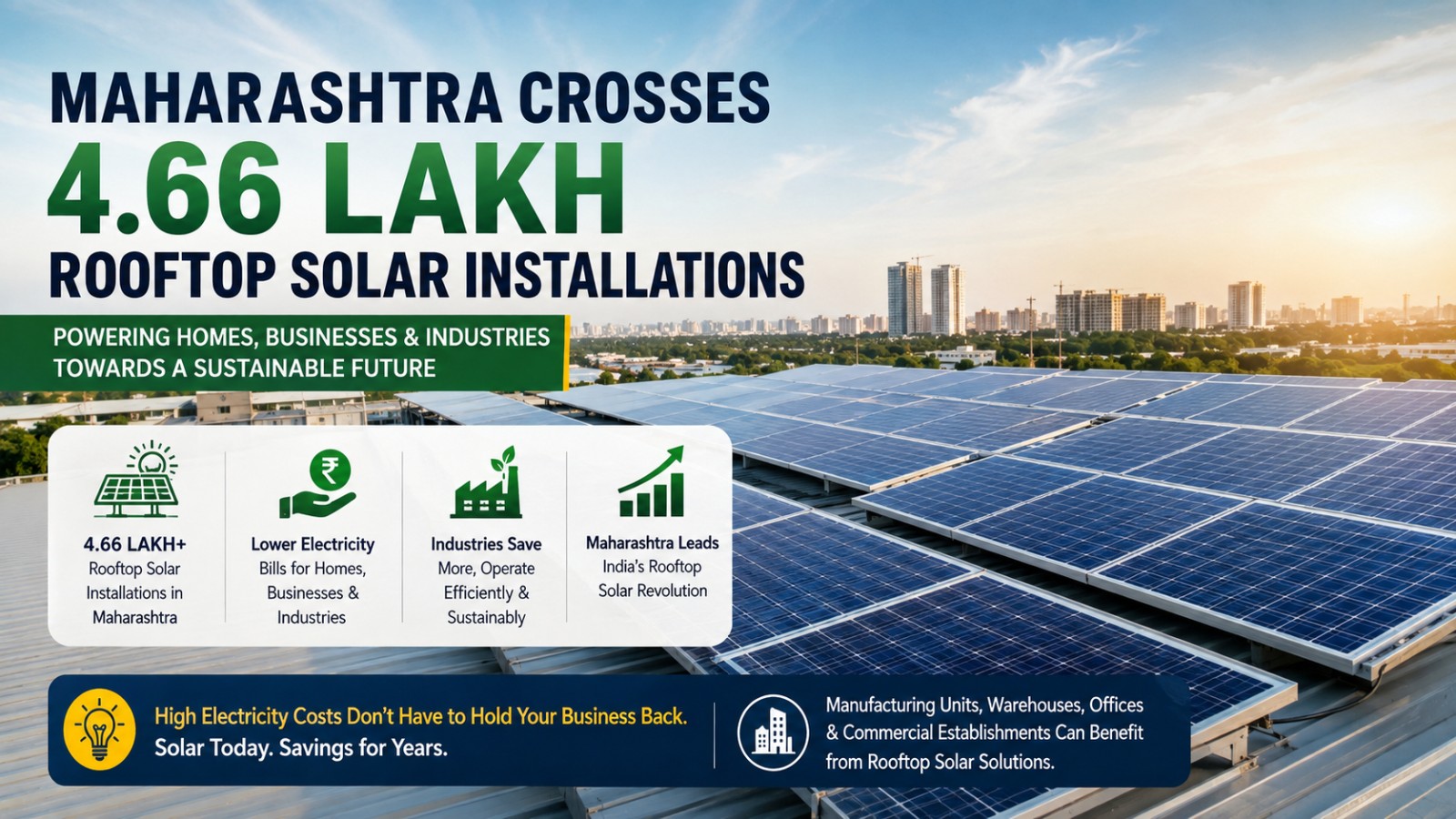
Maharashtra has emerged as one of India’s strongest markets for rooftop solar, reflecting a sharp rise in consumer interest in distributed renewable energy. The growth has been driven largely by the PM Surya Ghar: Muft Bijli Yojana, along with rising electricity costs, improving awareness and growing confidence in rooftop solar systems.
The state’s progress is particularly significant for Maharashtra’s wider energy economy. From homes and housing societies to commercial establishments, factories and industrial facilities, solar is increasingly being considered not only as a clean energy option but also as a long term electricity cost management strategy.
While the 4.66 lakh installation milestone represents an important stage in Maharashtra’s rooftop solar expansion, the state has continued to grow rapidly. By May 2026, Maharashtra had crossed six lakh rooftop solar installations under the national scheme, according to statements reported from Union Minister for New and Renewable Energy Pralhad Joshi. The state also recorded 4,700 rooftop solar installations in a single day on May 29, 2026.
The numbers show how quickly rooftop solar adoption is changing the electricity landscape in Maharashtra.
PM Surya Ghar Is Accelerating Rooftop Solar Adoption
The PM Surya Ghar: Muft Bijli Yojana was approved by the Union government in February 2024 with an overall financial outlay of ₹75,021 crore. The programme aims to support rooftop solar installations for one crore households by FY 2026 to 27.
The scheme is primarily designed for residential electricity consumers. Eligible households can receive central financial assistance based on the installed capacity. At the current benchmark, the subsidy is ₹30,000 for a 1 kW system, ₹60,000 for 2 kW and up to ₹78,000 for systems of 3 kW or more.
This financial support has reduced the initial barrier for many households considering solar.
However, the broader impact extends beyond residential consumers. The rapid expansion of rooftop solar is helping create greater awareness about solar economics among commercial and industrial electricity consumers, who often have very different consumption patterns and financial considerations.
Maharashtra’s Solar Growth Is Becoming a Business Story
For businesses, electricity is a recurring operating expense. Manufacturing plants, warehouses, offices, hotels, hospitals, educational institutions and commercial buildings can consume substantial amounts of electricity during daylight hours.
That makes rooftop solar particularly relevant.
A properly designed commercial or industrial solar plant can generate electricity during the same hours when a business is operating. Instead of purchasing every unit of daytime electricity from the grid, a business can generate a portion of its requirement from its own rooftop or available premises.
The financial benefit depends on several factors, including electricity consumption, tariff category, sanctioned load, available roof area, solar generation potential, system size, financing cost, tariff structure and applicable regulations.
This is why businesses should not rely on a generic solar price or savings estimate. A proper engineering assessment is more useful because the right system capacity needs to match the actual electricity profile of the facility.
What Rooftop Solar Can Mean for Industrial and Commercial Users
For a manufacturing unit, the objective is not simply to install as many panels as possible. The objective is to build a system that produces meaningful electricity savings without creating unnecessary capital expenditure.
A solar feasibility assessment normally considers roof strength, shadow conditions, usable area, electrical infrastructure, transformer capacity, historical electricity consumption and the operating pattern of the facility.
For example, a factory with substantial daytime electricity consumption may be able to use a significant share of its solar generation directly. This can improve the economics of the project because the generated electricity offsets electricity that would otherwise have been purchased from the grid.
Commercial buildings can also benefit from the same principle.
Offices, retail facilities, hospitals and other establishments with daytime loads may use rooftop solar to reduce their recurring electricity expenditure while improving their renewable energy credentials.
Why the Cost Saving Potential Matters
Solar should be viewed as an energy investment rather than simply an equipment purchase.
Once the system is installed and commissioned, sunlight becomes the energy source for generation. The business still has maintenance, financing and other operating considerations, but the solar plant can produce electricity for many years.
The potential savings therefore accumulate over the operating life of the system.
For businesses with high electricity consumption, even a reduction in the effective cost of a portion of daytime electricity can have a noticeable impact on annual operating expenses.
The exact return, however, varies from project to project. A manufacturing facility in Pune, a warehouse in Palghar and a commercial building in Mumbai may all require different system designs and may achieve different financial returns.
That is why an engineering led feasibility study is more valuable than simply comparing installation quotations.
Maharashtra’s Industrial Clusters Have a Strong Solar Opportunity
Maharashtra has a large concentration of manufacturing and commercial activity across regions such as Pune, Chhatrapati Sambhajinagar, Nashik, Nagpur, Thane, Palghar and the Mumbai Metropolitan Region.
Many facilities operate during daylight hours and have significant rooftop or industrial land availability.
This creates a natural opportunity for solar generation.
In regions where industrial electricity tariffs are significant, reducing dependence on grid electricity can become an important component of energy cost planning. Businesses that operate energy intensive machinery, production lines, refrigeration systems, compressors or large HVAC systems may particularly benefit from analysing their daytime electricity consumption.
The opportunity is not limited to large corporations. Medium sized factories, engineering units, warehouses and commercial properties can also evaluate solar based on their individual consumption and available space.
Delaying a Solar Decision Can Also Have a Cost
There is no universal deadline forcing every business to install solar immediately. However, delaying an investment decision can mean continuing to pay the full electricity cost while competitors and neighbouring businesses increasingly evaluate alternative energy sources.
Solar projects also require planning.
A commercial solar installation may involve site assessment, structural evaluation, system design, electrical planning, approvals, procurement, installation, testing and commissioning. Larger projects can require additional coordination with the electricity distribution infrastructure.
Businesses that begin the assessment early have more time to compare system configurations, financing options and expected savings.
The bigger point is simple: the first step does not have to be installation. It can simply be a feasibility assessment.
That allows a business owner to understand whether solar makes financial sense before committing capital.
Maharashtra’s Rooftop Solar Momentum Is Likely to Continue
The scale of adoption already recorded under PM Surya Ghar demonstrates the growing acceptance of rooftop solar in Maharashtra. In March 2026, the Union government reported more than 26.19 lakh rooftop solar systems installed nationally under the scheme, with ₹17,967.53 crore disbursed as central financial assistance as of March 19, 2026.
Maharashtra’s position among the leading states adds another dimension to this growth.
Nagpur alone had recorded 89,255 rooftop solar projects under PM Surya Ghar by June 2026, making it one of the strongest districts nationally and the leading district in Maharashtra at that point.
This concentration of adoption suggests that rooftop solar is moving beyond an early adopter market.
For Maharashtra’s business community, the question is increasingly shifting from whether solar works to whether solar works economically for a particular facility.
What Businesses Should Check Before Installing Solar
Before approving a rooftop solar project, business owners should consider:
1. Electricity consumption: Review at least 12 months of electricity bills to understand consumption patterns, demand charges and tariff structure.
2. Available roof area: The usable roof area should be assessed rather than relying on the total building area.
3. Structural suitability: Industrial roofs need a proper structural assessment before panels and mounting structures are installed.
4. Daytime load: A detailed load profile can help determine how much solar generation can be effectively used by the facility.
5. System capacity: he right capacity should be determined through engineering and financial analysis rather than choosing a standard system size.
6. Grid and regulatory requirements: The project should account for the applicable DISCOM process, electrical requirements, metering arrangements and other approvals.
7. Long term maintenance: Module cleaning, inverter performance, monitoring and preventive maintenance should form part of the project’s operating plan.
What This Means for Maharashtra Businesses
Maharashtra’s rooftop solar growth is no longer just a residential energy story. The rapid expansion of installations is strengthening the wider solar ecosystem, improving consumer awareness and encouraging businesses to examine their own energy costs.
For industrial and commercial users, the strongest reason to evaluate solar is financial discipline. Electricity is a recurring expense, and reducing the cost of a portion of that electricity can improve long term operating economics.
Businesses should also remember that every facility is different. A system that works well for one factory may not be suitable for another because of differences in tariff, load profile, roof size and operating hours.
Fore Point Solution works with businesses looking to evaluate rooftop and commercial solar requirements in Maharashtra. Instead of choosing a system only on its advertised capacity, businesses can assess their electricity consumption, available space, expected generation and project economics before making an investment decision.
If your factory, warehouse, office or commercial property is considering solar, visit Fore Point Solution to enquire about a suitable solar EPC solution and assess your site’s solar potential.
Frequently Asked Questions
Q1. How many rooftop solar installations has Maharashtra recorded?
Maharashtra crossed 4.66 lakh installations during its rapid expansion under the national rooftop solar programme. By May 2026, the state had subsequently crossed six lakh cumulative rooftop solar installations under PM Surya Ghar, according to statements reported by News On AIR.
Q2. Does PM Surya Ghar subsidy apply to commercial and industrial solar projects?
The PM Surya Ghar central subsidy is primarily intended for eligible residential consumers. Commercial and industrial consumers should not assume that the residential subsidy applies to their projects. Their solar economics should instead be evaluated based on electricity tariffs, consumption, system size, financing and applicable regulations.
Q3. Can a factory install rooftop solar in Maharashtra?
Yes. Industrial facilities can evaluate rooftop solar based on their electricity requirements, available roof area, structural suitability and applicable electricity regulations. A technical feasibility assessment should be completed before finalising the system.
Q4. How much can a business save with solar?
There is no single saving figure applicable to every business. Savings depend on electricity consumption, tariff, solar system capacity, generation, self consumption, financing and operating conditions. A project specific financial analysis provides a more reliable estimate.
Q5. Why is daytime electricity consumption important?
Solar panels generate electricity during daylight hours. Businesses with substantial daytime loads can potentially use more of their solar generation directly, which can improve the financial performance of the project.
Q6. Should businesses wait before installing solar?
Waiting may allow a business to gather more information, but it also means continuing to pay the existing electricity cost. A better first step is to conduct a feasibility and financial assessment so the business can make an informed decision.
Q7. What should a business check before selecting a solar EPC company?
Businesses should evaluate engineering capability, installation experience, equipment quality, electrical design, project execution, documentation, monitoring and after sales support. The lowest quotation is not necessarily the lowest cost over the project’s operating life.


