


Maharashtra’s New Solar Rule: Projects Above 100 kW to Require Battery Storage

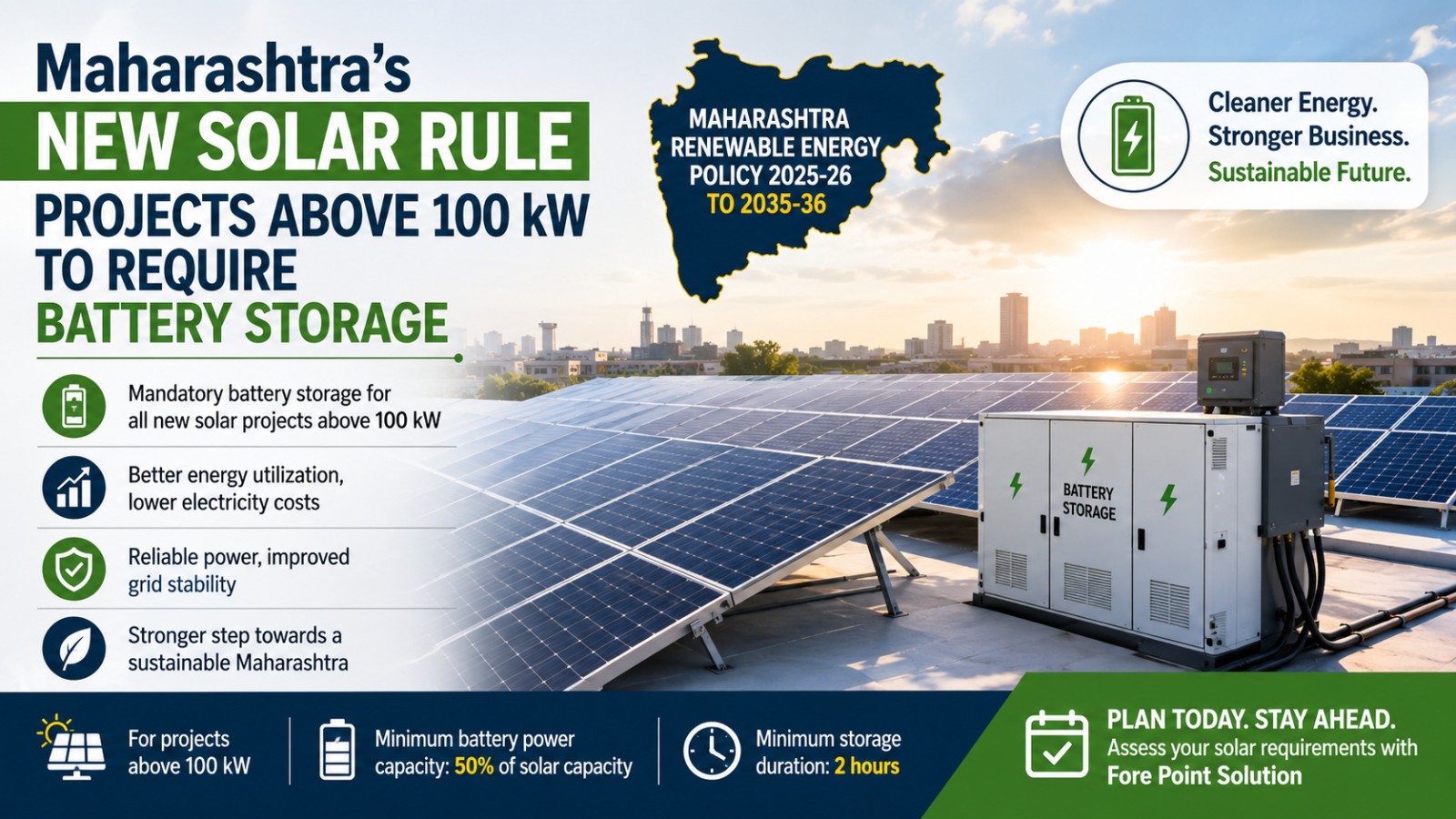
Maharashtra’s solar sector has entered a new phase in 2026, with battery storage becoming an important part of larger renewable energy projects. Under the state’s Renewable Energy and Energy Storage Policy 2025-26 to 2035-36, new rooftop, captive and open access renewable energy projects above 100 kW are required to integrate battery energy storage. The policy was notified by the Maharashtra government in March 2026, with the relevant storage requirement taking effect from April 1, 2026.
For industrial units, factories, commercial buildings and other businesses planning a solar installation, this changes the way projects need to be planned and budgeted. Solar panels alone may no longer be enough for projects crossing the 100 kW threshold. Businesses now need to consider solar generation, battery capacity, load patterns, grid connectivity and the overall economics together.
The change is significant because Maharashtra has a large base of manufacturing facilities, MSMEs, commercial establishments and industrial consumers that operate with substantial daytime and evening electricity requirements.
What Is the New Maharashtra Solar Storage Rule?
The new policy requires qualifying new solar projects above 100 kW to include battery storage. The minimum storage requirement is linked to the renewable energy capacity, with battery power capacity set at at least 50% of the solar capacity and a minimum storage duration of two hours under the current requirement.
For example, a business planning a 200 kW solar project would need to consider at least 100 kW of battery discharge capacity with two hours of storage, equivalent to around 200 kWh of usable energy capacity.
Similarly, for a 500 kW solar project, the minimum battery power requirement would work out to 250 kW, with two hours of storage translating to about 500 kWh of energy capacity.
The requirement is therefore not simply about adding a small backup battery. Businesses planning larger solar installations need an appropriately designed Battery Energy Storage System, commonly known as BESS.
The policy is also designed to become more demanding over time. Industry reports on the notified policy indicate that the storage duration requirement is expected to increase to four hours for projects commissioned from FY 2030-31 onwards, while the 50% capacity ratio remains.
Why Is Maharashtra Bringing Battery Storage Into Solar Projects?
Solar power production is naturally concentrated during daylight hours. A factory, warehouse or commercial building, however, may continue consuming substantial electricity after sunset.
Without storage, excess solar generation during the day may be exported to the grid depending on the applicable arrangement. With a battery, part of that energy can instead be stored and used when the facility needs it later.
This gives businesses greater control over when solar electricity is consumed.
Battery storage can also help address one of the biggest challenges associated with increasing renewable energy adoption: matching intermittent solar generation with actual electricity demand.
For Maharashtra’s industrial and commercial consumers, this becomes particularly relevant as electricity costs, time of day consumption and grid related charges can influence the economics of a solar investment.
What Does the Rule Mean for Industrial and Commercial Businesses?
For a business planning a solar project above 100 kW, the project cost and technical design now need to be evaluated differently.
Previously, a company could primarily compare solar panel capacity, inverter capacity, installation cost and expected generation. With storage included, the assessment becomes broader.
Businesses should now examine:
1. Solar Capacity and Battery Sizing
The battery cannot simply be selected based on available budget or floor space. Its power rating and energy capacity need to correspond with the solar project and the facility’s electricity consumption.
A factory operating multiple machines in the evening, for example, may have a very different storage requirement from an office building that consumes most of its electricity during working hours.
2. Load Profile
A detailed analysis of hourly electricity consumption can help determine how effectively the battery will be used.
Businesses should understand when their highest electricity demand occurs, how much solar power is consumed directly, how much is exported and how much electricity is purchased from the grid after solar generation falls.
This information can make a significant difference to the financial case for storage.
3. Available Roof and Electrical Infrastructure
Large rooftop projects require more than adequate roof space. The electrical system, transformer capacity, inverter configuration, protection equipment, cable routes and battery installation area also need to be evaluated.
A proper site survey before finalising the project can prevent costly changes later.
Can Battery Storage Help Reduce Business Electricity Costs?
Yes, but the actual savings will depend heavily on the business’s consumption pattern, tariff structure, solar generation, battery size, operating strategy and applicable grid regulations.
One of the key advantages of BESS is the ability to shift electricity generated during solar hours to periods when the business needs power later. This can improve solar self consumption and potentially reduce dependence on grid electricity during higher cost periods.
Storage can also provide a degree of operational resilience, depending on how the system is configured. Critical loads may be supported during certain grid interruptions, although businesses should not automatically assume that every solar plus battery installation will provide full facility backup.
The financial calculation therefore needs to consider both the additional upfront investment and the potential operational benefits over the battery’s useful life.
Battery Storage Is Becoming a Larger Solar Industry Trend
Maharashtra’s policy reflects a wider shift in the renewable energy industry. Solar generation is increasingly being combined with energy storage rather than being treated as a standalone electricity source.
The state itself is moving toward greater use of storage. Maharashtra has recently invited interest for an 11 MW floating solar project combined with a 5.5 MW battery energy storage system at Veer reservoir in Satara, showing how solar plus storage is moving into larger energy projects as well.
For businesses, this means storage is becoming more than a technology for backup power. It is increasingly part of the broader energy management strategy.
What Should Businesses Do Before Planning a Solar Project?
Companies considering a solar installation above 100 kW should avoid finalising the project based only on the lowest EPC quotation.
A better approach is to start with an energy assessment.
The assessment should consider the company’s sanctioned load, historical electricity bills, hourly consumption, operating hours, peak demand, available rooftop area, proposed solar capacity and expected future expansion.
The EPC design should then determine the appropriate solar and battery configuration.
This is especially important for manufacturing units that may increase production capacity in the coming years. Designing only for today’s electricity consumption could result in an undersized system, while excessive capacity could unnecessarily increase project costs.
Why Delaying the Planning Process Could Cost Businesses an Opportunity
Businesses that were already considering solar should not interpret the new rule as a reason to abandon their plans. Instead, it is a reason to conduct a more detailed feasibility study before making an investment.
Solar projects above 100 kW now need storage considerations from the beginning. Companies that postpone technical assessment may face longer planning cycles, changing equipment requirements or difficulty comparing quotations when they eventually enter the market.
There is also a practical advantage to planning early. Businesses can compare different battery technologies, system configurations, financing options and EPC proposals before committing to a final design.
For manufacturers and commercial consumers with substantial electricity bills, waiting without assessing the new requirements could mean losing valuable time in reducing long term energy costs.
Fore Point Solution Can Help Businesses Plan Solar Plus Storage
For industrial, commercial and manufacturing businesses in Maharashtra, the right solar project now requires more than selecting panels and installing them on the roof.
Fore Point Solution can help businesses assess their solar requirements, evaluate site conditions and understand suitable solar EPC solutions based on their electricity consumption and project requirements.
If your factory, warehouse, commercial property or business is planning a solar project above 100 kW, this is a good time to assess the project under the new storage framework rather than treating battery integration as an afterthought.
Visit forepoint.in to enquire about suitable solar EPC solutions and assess your commercial or industrial solar requirements.
Frequently Asked Questions
Q1. Does every solar project in Maharashtra require a battery?
No. The new storage requirement is particularly relevant to new renewable energy projects above the 100 kW threshold covered by the state policy. Smaller projects are not subject to this specific mandatory storage requirement.
Q2. How much battery storage is required for a 200 kW solar project?
Under the current requirement, a 200 kW project would need battery power capacity of at least 100 kW with a minimum two hour duration. That corresponds to approximately 200 kWh of energy storage.
Q3. Does the rule apply to existing solar installations?
The reported requirement applies to new projects and new grid connectivity applications covered by the policy. Existing solar installations should not be assumed to require immediate battery installation solely because they exceed 100 kW. Businesses should verify the specific applicability to their project with the relevant authorities and EPC provider.
Q4. Will batteries increase the cost of a commercial solar project?
Yes. Battery storage adds equipment, installation and associated electrical infrastructure costs. However, the financial impact should be evaluated alongside potential benefits such as greater solar self consumption, peak demand management and reduced grid dependence.
Q5. Will the battery provide backup power during a power cut?
It can, if the system is specifically designed to support backup or critical loads. A standard grid connected solar plus battery system should not automatically be considered a complete backup solution for an entire factory or commercial facility.
Q6. Will the storage requirement become stricter in the future?
The policy direction indicates an increase in the required storage duration for projects commissioned from FY 2030-31 onwards. Businesses planning long term projects should therefore consider future requirements during the initial design stage.
Q7. What should a business do before installing a solar system above 100 kW?
Start with a technical and financial feasibility assessment. Review electricity bills, load profile, operating hours, sanctioned load, roof area, proposed solar capacity and battery requirement. A qualified solar EPC company can then develop a project design that considers both current requirements and future expansion.


