


MNRE ALMM List II Update: Avaada Electro Adds 3,011 MW N Type TOPCon Cell Capacity in Maharashtra

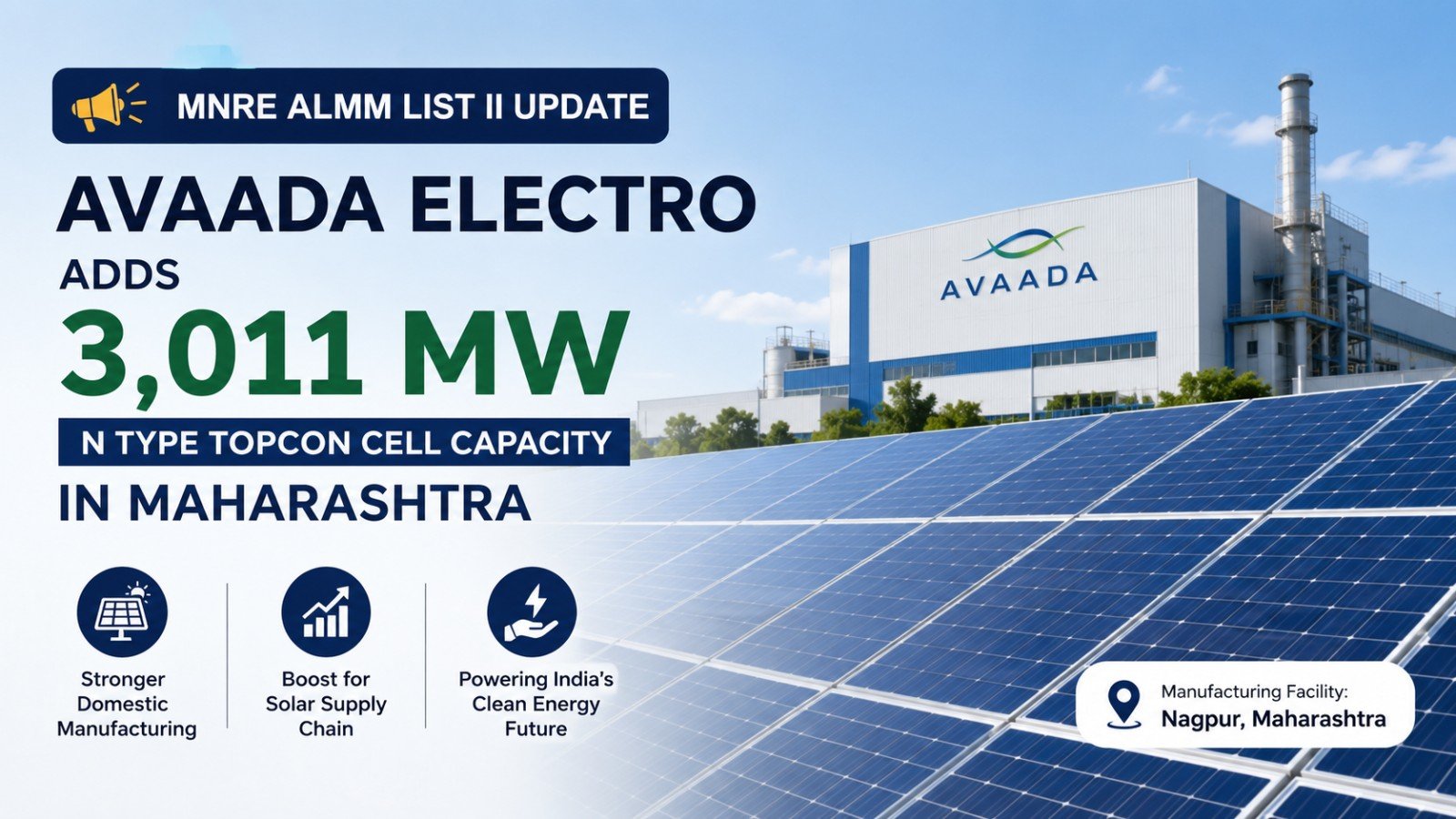
Maharashtra is strengthening its position as one of India’s important solar manufacturing hubs as Avaada Electro’s solar cell capacity in Nagpur gains a major boost under the latest MNRE Approved List of Models and Manufacturers framework. In the latest update, Avaada Electro has added 3,011 MW of N type TOPCon solar cell capacity, taking its listed manufacturing capacity to 3,621 MW.
The development is significant for Maharashtra’s growing solar ecosystem because domestic manufacturing capacity is expanding alongside rising demand for rooftop, commercial, industrial and utility scale solar projects. The Ministry of New and Renewable Energy has been regularly revising ALMM List II for solar PV cells since its first release in July 2025. The ninth revision was issued on August 21, 2026.
For industrial and commercial businesses considering solar, the development is more than a manufacturing milestone. It reflects a broader shift toward higher efficiency solar technologies, stronger domestic supply chains and greater availability of advanced N type TOPCon technology for future projects.
Ready to Reduce Your Electricity Bills with Solar?
Find out how much you can save before future policy changes and rising demand increase costs. Get expert guidance on the right solar system and available subsidy benefits.
Avaada Electro Expands Its Solar Cell Capacity in Maharashtra
Avaada Electro’s manufacturing facility is located in the Butibori Industrial Area near Nagpur, Maharashtra. The company has been expanding its solar manufacturing capabilities across modules and cells, with N type TOPCon technology becoming an important part of its product strategy.
The latest ALMM List II update shows Avaada Electro with 3,621 MW of enlisted capacity, following the addition of 3,011 MW. The development comes at a time when India is rapidly increasing domestic solar cell manufacturing to support the growth of solar installations and reduce dependence on imported components.
The earlier ALMM update in July 2026 had already added Avaada Electro to the solar cell list with 610 MW of N type TOPCon G12 cell capacity from its Nagpur facility. The approved cell technologies included half cut and full cell G12 configurations, with average efficiencies above 25%.
The latest capacity increase therefore represents a substantial expansion of Avaada Electro’s listed cell manufacturing footprint in Maharashtra.
Why N Type TOPCon Matters for Commercial and Industrial Solar
N type TOPCon has quickly become one of the leading technologies in the solar industry because it can provide higher efficiency and improved performance compared with older cell technologies.
For businesses, efficiency is particularly important because rooftop space is limited. A higher efficiency module can generate more electricity from a given roof area, which can be valuable for factories, warehouses, commercial buildings and manufacturing facilities with high daytime electricity consumption.
TOPCon technology also offers advantages related to lower degradation and temperature performance. These characteristics can support stronger long term energy generation when the modules are properly designed, installed and maintained.
For a business owner, the practical question is not simply which technology is newer. It is whether the selected system can produce more useful electricity from the available roof space and deliver an attractive return on the investment.
What This Means for Maharashtra Businesses
The expansion of solar cell manufacturing in Maharashtra comes as businesses across the state continue to look for ways to control electricity costs.
Industrial and commercial consumers often have substantial daytime power demand. Manufacturing equipment, HVAC systems, refrigeration, pumps, compressors and other machinery can create significant electricity consumption throughout operating hours.
A properly designed rooftop solar system can offset part of this daytime demand and reduce dependence on grid electricity.
The financial benefit will vary from one business to another. System size, electricity tariff, operating hours, rooftop conditions, generation, financing cost, maintenance and applicable regulations all influence the actual savings.
This is why businesses should focus on a project specific feasibility assessment rather than relying on a generic solar savings percentage.
Higher Manufacturing Capacity Could Improve Solar Supply Options
A growing domestic cell manufacturing base can have wider implications for solar project developers and EPC companies.
More domestic manufacturing capacity can support supply chain diversification while increasing the availability of newer solar technologies. For businesses planning larger rooftop projects, this can make technology selection and procurement an increasingly important part of project planning.
The trend is already visible in the continuing revisions of ALMM List II. MNRE’s official ALMM page shows multiple revisions during 2026, reflecting changes in listed manufacturers, capacities and approved solar cell models.
This also means businesses should avoid treating an old equipment list or an outdated quotation as a permanent reference. Solar technology and regulatory requirements are moving quickly.
ALMM List II and Residential Solar: Why Businesses Should Understand the Difference
There is often confusion between ALMM List I and ALMM List II.
ALMM List I primarily concerns approved solar PV module models and manufacturers, while ALMM List II relates to solar PV cells and their manufacturers under the applicable framework. MNRE states that the first ALMM List for solar PV cells was issued in July 2025 and is being updated regularly.
Businesses and homeowners should therefore check the exact requirement applicable to their project instead of assuming that every solar installation follows the same ALMM conditions.
For readers researching residential requirements, our guide on ALMM List II for Residential Solar explains the difference between List I and List II, eligibility considerations and what homeowners should check before selecting solar equipment.
The Cost Saving Opportunity for Industrial and Commercial Users
For a manufacturing unit, warehouse or commercial facility, the economics of solar are usually driven by the amount of electricity that can be displaced.
Consider a business operating primarily during daylight hours. Solar generation during those operating hours can directly offset grid consumption. The larger the suitable daytime load, the greater the potential value of the generated electricity.
A professional feasibility study should consider:
- Current monthly electricity consumption
- Electricity tariff and demand charges
- Available rooftop area
- Daytime operating load
- Shading and structural conditions
- Suitable system capacity
- Module and inverter technology
- Net metering or other applicable regulatory arrangements
- Financing and payback expectations
- Operation and maintenance requirements
The objective should be to design a system around the business’s actual energy profile rather than simply installing the largest possible plant.
Why Businesses Should Not Delay Solar Planning
Solar projects require more planning than simply purchasing panels and installing them on a roof.
Businesses need to evaluate structural suitability, electrical infrastructure, approvals, equipment availability, project economics and installation timelines. Larger industrial projects can also require detailed engineering and coordination with multiple stakeholders.
Waiting until electricity costs become a major concern can limit the time available to evaluate these factors properly.
At the same time, the solar industry is moving toward higher efficiency modules, larger manufacturing capacities and more advanced technologies. Businesses that begin evaluating their requirements earlier can compare technology options, understand project economics and plan investment decisions with greater clarity.
The objective is not to rush into a solar installation. It is to avoid delaying the feasibility assessment until a business is under pressure to reduce operating costs.
What Maharashtra Businesses Should Do Next
Industrial, commercial and manufacturing businesses considering rooftop solar should start with an energy and site assessment.
Review the previous 12 months of electricity bills, identify the facility’s daytime consumption and evaluate the usable rooftop or available project area. From there, an EPC company can determine an appropriate system size and estimate expected generation and financial returns.
Businesses should also ask for clear information about the proposed modules, inverter, mounting structure, warranties, installation scope and applicable regulatory requirements.
As solar technology continues to evolve, selecting equipment based only on the lowest initial quotation may not deliver the best long term value.
Plan Your Solar Project With Fore Point Solution
For businesses in Maharashtra looking to reduce electricity costs through solar, Fore Point Solution can help assess the technical and commercial feasibility of a suitable solar EPC project.
Whether you operate a manufacturing facility, warehouse, commercial property or industrial unit, the right system should be designed around your electricity consumption, available space and investment objectives.
Assess your current electricity usage and enquire with Fore Point Solution about a suitable commercial or industrial solar EPC solution: forepoint.in
For more updates on Maharashtra’s solar policies, manufacturing developments and renewable energy industry trends, follow the Fore Point Solution News section for timely solar market information.
Frequently Asked Questions
Q1. What is the latest Avaada Electro ALMM List II update?
The latest MNRE ALMM List II update shows Avaada Electro with 3,621 MW of enlisted solar cell manufacturing capacity after a 3,011 MW addition. The capacity is associated with its manufacturing operations in Nagpur, Maharashtra.
Q2. What technology is Avaada Electro expanding?
Avaada Electro is expanding its N type TOPCon solar cell manufacturing capabilities. The company’s approved solar cell portfolio includes G12 configurations with high efficiency characteristics.
Q3. Why is TOPCon important for businesses?
N type TOPCon can provide high conversion efficiency and strong performance characteristics, making it useful where businesses want to generate more electricity from limited rooftop space.
Q4. Does ALMM List II mean approved solar panels?
Not exactly. ALMM List II concerns solar PV cells and manufacturers, while ALMM List I concerns approved solar PV module models and manufacturers. Businesses should check the applicable MNRE requirement for their specific project.
Q5. Can industrial businesses benefit from higher efficiency solar modules?
Yes. Higher efficiency modules can help maximise generation where usable roof space is limited. The actual financial benefit depends on the facility’s electricity consumption, tariff, operating pattern, system size and other project conditions.
Q6. Should Maharashtra businesses wait before installing solar?
Businesses should not rush into a project, but they should also avoid unnecessary delays in evaluating it. Early feasibility assessment allows companies to understand their electricity consumption, available roof area, project cost, expected generation and potential savings before making an investment decision.
Q7. Where can businesses get a solar EPC assessment in Maharashtra?
Businesses can approach Fore Point Solution for an assessment of their commercial or industrial solar requirements and discuss suitable EPC solutions based on their facility, electricity consumption and project objectives.


