


Solar Power Purchase Agreement (PPA): A Complete Guide for Businesses in India

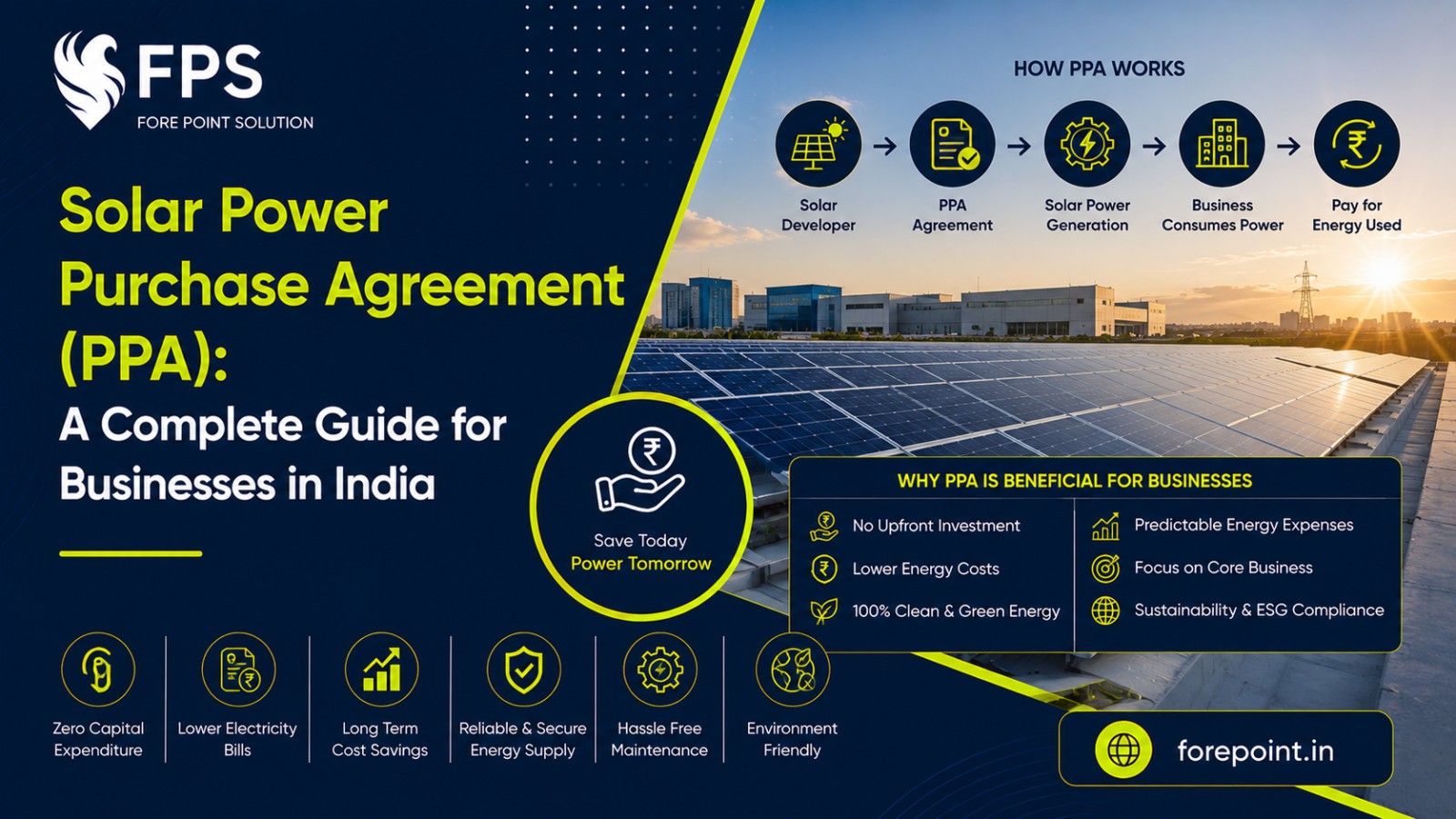
Electricity is one of the major operating expenses for many businesses in India. Manufacturing units, warehouses, hotels, hospitals, offices and commercial buildings often use large amounts of power throughout the year. As electricity costs remain an important part of business planning, many companies are considering solar power without necessarily wanting to purchase and maintain a complete solar plant themselves.
A Solar Power Purchase Agreement (PPA) can be one option for such businesses. Under a PPA, a business agrees to purchase electricity generated by a solar project for a defined period and at agreed commercial terms. The solar project may be developed, owned and maintained by another party, depending on the structure of the agreement.
For businesses considering Solar PPA in India, understanding the contract, pricing, project ownership, electricity supply arrangement and responsibilities is important before signing anything.
Ready to Reduce Your Electricity Bills with Solar?
Find out how much you can save before future policy changes and rising demand increase costs. Get expert guidance on the right solar system and available subsidy benefits.
What Is a Solar Power Purchase Agreement?
A Solar Power Purchase Agreement (PPA) is a long term contract between a power producer and a power consumer. The producer develops or operates a solar power project and sells the generated electricity to the customer under agreed terms.
The agreement generally specifies the electricity price, contract period, expected generation, payment terms, project responsibilities and conditions for ending or changing the agreement.
Unlike purchasing a solar plant outright, a PPA can allow a business to access solar electricity without taking responsibility for the entire upfront capital investment. The exact arrangement depends on whether the project is located on the customer’s premises or at another site.
For a business, the most important point is simple: read the PPA as a commercial contract, not just as a solar quotation.
How Does Solar PPA for Businesses Work?
In a typical Solar PPA for businesses, the solar developer arranges the project financing, installation and maintenance according to the agreed structure. The business purchases the electricity generated by the project at the contracted rate.
For an onsite arrangement, solar panels may be installed on the company’s rooftop or available premises. The generated electricity can be supplied to the business according to the agreed electrical and regulatory arrangement.
In an offsite arrangement, the solar project may be located elsewhere and electricity can be supplied through the applicable power procurement mechanism.
The commercial structure can vary considerably. Therefore, businesses should understand whether the proposed PPA is onsite, offsite, group captive, open access or another permitted structure before comparing offers.
Why Are Businesses Considering Solar PPAs?
The biggest attraction is often the possibility of accessing solar electricity without purchasing the entire system upfront.
A company that does not want to allocate significant capital to a solar plant may consider a PPA where another party invests in the project. The business then pays for the electricity according to the agreed terms.
This can make solar easier to evaluate as an operating expense rather than a large capital expenditure, depending on the agreement.
A PPA can also provide greater visibility into electricity costs. However, the actual financial benefit depends on the contracted solar tariff, applicable grid charges, taxes, wheeling or transmission charges, regulatory requirements and the business’s existing electricity tariff.
Commercial Solar PPA and Electricity Savings
A Commercial solar PPA should always be evaluated against the business’s current electricity cost.
For example, a factory may currently purchase electricity from the grid at a certain effective rate. A solar PPA may offer a different energy rate. But the comparison should not stop at these two numbers.
Businesses should also examine demand charges, transmission or wheeling charges where applicable, banking arrangements, taxes, duties and other charges that may affect the final delivered electricity cost.
The PPA should clearly explain what the customer will actually pay and which costs remain outside the contracted solar energy price.
This is particularly important for businesses considering offsite solar arrangements.
Key Solar PPA Benefits
There can be several Solar PPA benefits, depending on the project structure and contract.
The first is reduced upfront capital expenditure. Instead of purchasing the entire solar plant, the business may purchase electricity generated by the project.
Another potential benefit is reduced responsibility for system maintenance. In many PPA structures, the project owner handles operation and maintenance, although the exact responsibility must be clearly stated in the contract.
A PPA can also help businesses plan long term electricity procurement. For companies with predictable power consumption, a well structured agreement can provide greater visibility into a portion of future electricity costs.
However, these benefits should be assessed against the contract duration and obligations. A low initial tariff does not automatically make a PPA commercially attractive.
Important Clauses to Check Before Signing
A business should carefully review several clauses before signing a Solar Energy PPA.
The electricity tariff and escalation mechanism should be clearly stated. Check whether the price remains fixed or increases periodically.
The contract duration is equally important. Long term PPAs can create obligations that continue for many years.
Businesses should also check the minimum purchase commitment, if any. Some agreements may include provisions related to minimum energy offtake.
Performance guarantees should also be examined. The agreement should explain what happens if the solar project generates less electricity than expected.
Other important provisions include payment terms, late payment consequences, insurance, equipment ownership, maintenance responsibility, force majeure, regulatory changes, termination, default and dispute resolution.
What Happens If Solar Generation Is Lower Than Expected?
Solar generation naturally varies according to sunlight, weather, equipment performance and system availability. A well drafted PPA should address generation shortfalls.
The agreement may contain provisions related to minimum generation, availability or compensation. The exact mechanism varies between contracts.
Businesses should not assume that the developer will automatically compensate them for every reduction in solar generation.
Ask the provider to explain how performance is measured, what data is used and what remedies are available if the project consistently fails to meet contractual expectations.
Solar PPA vs Buying a Solar System
The decision between a PPA and purchasing a solar plant depends on the business’s financial position and long term objectives.
With outright purchase, the business invests capital in the solar system and generally owns the asset. It may also be responsible for maintenance and operational decisions.
With a PPA, another party may own and operate the system while the business purchases electricity under the agreement.
A business with available capital may prefer ownership because it has greater control over the asset. A company focused on preserving capital may consider a PPA.
Both options should be compared using total project cost, expected electricity generation, savings, maintenance, financing, tax treatment and contract obligations.
Is Solar PPA Suitable for Every Business?
No. A PPA is more suitable when the business has consistent electricity consumption and can commit to the contractual period.
Factories, warehouses, large offices, hotels, hospitals and other commercial facilities may have suitable consumption profiles.
Businesses with unpredictable operations or plans to relocate should be more careful before signing a long term agreement.
The available rooftop area, electricity connection, state regulations and project structure also influence whether a PPA is practical.
Choose Fore Point Solution for Your Solar Requirement
If your business is considering rooftop solar or evaluating a solar power procurement model, Fore Point Solution can help assess your electricity consumption, site conditions and solar requirements.
Before choosing between a solar PPA and direct solar installation, businesses should compare both options based on expected electricity savings, project cost, system ownership, maintenance responsibilities and long term financial impact.
Planning solar for your commercial or industrial property? Contact Fore Point Solution to discuss your electricity requirements and suitable solar installation options.
Conclusion
A Solar Power Purchase Agreement (PPA) can provide businesses with an alternative way to access solar electricity without necessarily purchasing the entire solar plant upfront.
But the financial benefit depends heavily on the terms of the agreement. Tariff, escalation, contract duration, minimum purchase obligations, generation guarantees, regulatory charges and termination conditions all need careful review.
Businesses should compare a Solar PPA in India with outright solar ownership before making a decision. The right option is the one that fits the company’s electricity consumption, cash flow, operating plans and long term energy strategy.
A qualified legal and financial advisor should review the final PPA before signing, particularly for large commercial or industrial projects.
Frequently Asked Questions
Q1. What is a Solar Power Purchase Agreement?
A Solar Power Purchase Agreement is a contract under which a business purchases electricity generated by a solar project from a project owner or developer under agreed commercial terms.
Q2. Is a Solar PPA suitable for small businesses?
It can be, but suitability depends on electricity consumption, project size, contract terms and the available solar structure. Smaller businesses should compare the PPA economics carefully with a direct rooftop installation.
Q3. What are the main Solar PPA benefits?
Potential benefits include lower upfront capital requirements, predictable electricity procurement and reduced responsibility for operating and maintaining the solar asset, depending on the contract.
Q4. What is the difference between a Solar PPA and buying solar panels?
With direct purchase, the business generally owns the solar asset. Under a PPA, another party may own the project while the business purchases the electricity generated under the agreement.
Q5. How long does a commercial solar PPA last?
The duration depends on the agreement. Commercial PPAs are generally structured as long term contracts, so businesses should carefully review the complete contract period before signing.
Q6. Can a Solar PPA reduce business electricity costs?
It can potentially reduce electricity costs if the contracted solar electricity price and all associated charges are favourable compared with the business’s existing electricity cost. A detailed financial comparison is required.
Q7. What should businesses check before signing a Solar PPA?
Review the tariff, escalation, contract period, minimum purchase obligations, generation guarantees, maintenance responsibilities, payment terms, termination clauses, regulatory charges, insurance and dispute resolution provisions.


