



Maharashtra Manufacturing Unit Cuts Grid Power by 20 MWh/Month With 600 kW BESS

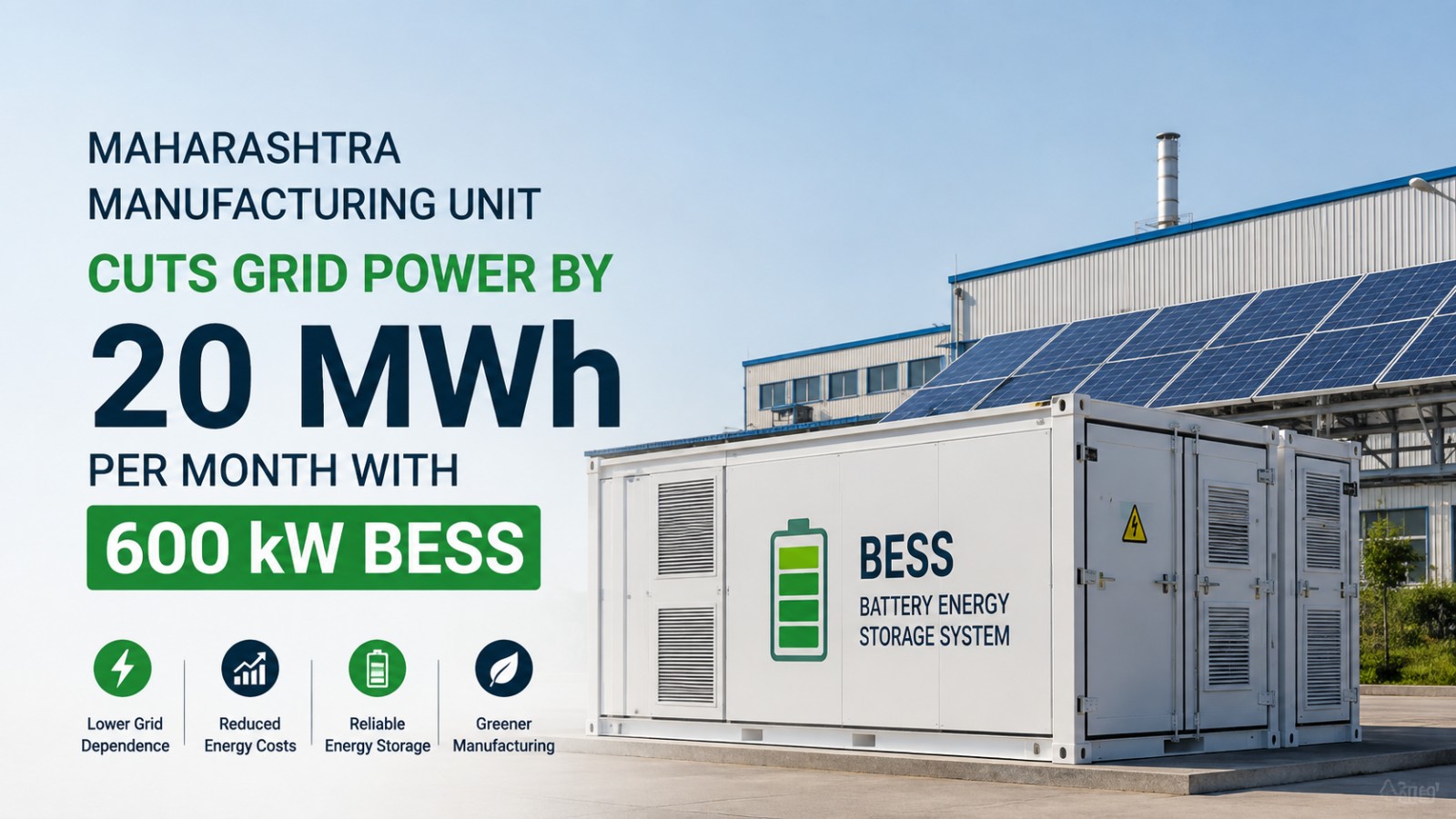
A manufacturing facility in Maharashtra is highlighting the growing role of battery energy storage in managing industrial electricity demand, with a 600 kW Battery Energy Storage System (BESS) reportedly helping the unit reduce its dependence on grid power by around 20 MWh per month.
The development reflects a broader shift taking place across Maharashtra’s industrial sector. For factories operating energy intensive machinery, compressors, motors, HVAC systems and production lines, electricity is no longer simply an operating expense. Managing when and how that electricity is consumed is becoming an important part of controlling production costs.
The 600 kW BESS case also illustrates why industrial consumers are increasingly looking beyond conventional rooftop solar. Solar can reduce daytime grid consumption, but battery storage can add another layer of control by shifting available energy to periods when electricity demand or tariffs are higher.
Why BESS Is Becoming Relevant for Maharashtra Industries
Manufacturing companies typically have predictable but demanding electricity profiles. Production may continue for extended shifts, while peak demand can increase sharply when several machines operate simultaneously.
A battery energy storage system provides an additional way to manage that demand. Instead of depending entirely on electricity from the grid at every moment, a properly designed BESS can store electricity and discharge it according to the facility’s operating requirements.
This becomes particularly useful when the battery is integrated with rooftop solar.
During periods of strong solar generation, excess electricity can be directed toward battery charging instead of being wasted or exported at a relatively lower value. Later, the stored electricity can support the facility when solar generation falls and grid electricity becomes more expensive.
Maharashtra’s renewable energy policy direction is also putting greater emphasis on storage. The state’s policy framework provides for minimum storage requirements for new renewable energy projects above 100 kW, beginning with storage equivalent to 50% of renewable capacity for two hours, subject to the applicable regulatory implementation. The policy also promotes solar plus storage solutions around urban and industrial clusters.
What a 600 kW BESS Can Change for a Factory
The headline figure in this case is the reported reduction of approximately 20 MWh of grid electricity consumption every month.
That represents around 240 MWh, or 240,000 kWh, over a full year if the monthly reduction remains consistent.
However, the financial value of those avoided units depends on the factory’s tariff structure, time of day consumption, demand charges, solar generation, battery utilisation and operating schedule.
This is an important distinction for businesses considering BESS. A 600 kW battery system should not automatically be viewed as a fixed saving of a particular rupee amount. The economics have to be calculated from the individual facility’s load profile.
For an industrial consumer, the battery may create value through several channels.
First, it can reduce grid consumption during expensive periods. Second, it can increase the utilisation of rooftop solar by storing surplus generation. Third, it can help manage short duration power interruptions and fluctuations. Fourth, it can reduce the need to operate diesel based backup equipment for certain applications, depending on the facility’s electrical configuration.
The result is not simply lower electricity consumption. It is greater control over when electricity is purchased and consumed.
Solar Plus Storage Is Becoming a Stronger Industrial Proposition
For years, rooftop solar was primarily positioned as a way to reduce daytime electricity bills. That proposition remains important, but the growth of battery storage is changing the way businesses can design their energy systems.
A factory with significant daytime solar generation may still face a mismatch between generation and consumption. Production schedules do not always correspond perfectly with solar availability.
A BESS can bridge part of that gap.
For example, electricity generated during the middle of the day can be stored and subsequently discharged during an evening production shift. This can improve solar self consumption and reduce reliance on grid electricity outside solar generation hours.
The trend is already visible in Maharashtra’s commercial and industrial market. Tata Power Renewable Energy held a C&I focused initiative in Pune in February 2026 specifically aimed at helping industries, including steel, automotive, engineering and manufacturing businesses, evaluate renewable energy and BESS solutions.
At the larger end of the market, GAIL has also announced a 100 MW solar project with a 22 MWh BESS in Maharashtra to support captive requirements at its PDH PP plant in Raigad district.
These developments indicate that energy storage is moving from a specialised technology discussion toward a practical consideration for industrial energy planning.
The Business Case Goes Beyond the Electricity Bill
For manufacturing businesses, power reliability can be just as important as the price of electricity.
An unexpected interruption can stop production, disrupt automated processes, affect temperature controlled operations and create restart costs. In some industries, even a short interruption can have consequences that extend beyond the actual duration of the power failure.
A BESS can provide fast electrical response when configured for backup and power quality applications. The exact level of protection depends on the battery capacity, inverter configuration, critical loads and the facility’s electrical architecture.
This means businesses should not evaluate BESS only by asking how many units of electricity the battery can store.
The more useful question is: What problem is the battery being installed to solve?
For one factory, the priority may be peak demand management. For another, it may be solar self consumption. A third may prioritise backup for critical machinery. Some businesses may require a combination of these objectives.
Why Industrial Businesses Should Start Assessing Storage Now
The BESS market is developing rapidly in Maharashtra. In April 2026, Neuron Energy commissioned a BESS manufacturing facility in Talegaon with an annual production capacity of 5 GWh, demonstrating the increasing scale of the state’s energy storage ecosystem.
Maharashtra is also pursuing larger grid scale storage projects. MSEDCL has issued tender documentation relating to 2,000 MW/4,000 MWh of BESS capacity under tariff based competitive bidding.
For industrial consumers, this creates an important opportunity.
Businesses that begin evaluating their electricity profile early can compare solar generation, battery sizing, tariff exposure, demand patterns and expected payback before making a capital investment. Waiting until electricity costs rise further or operational requirements change can leave less time to optimise the system.
At the same time, BESS should not be treated as a one size fits all product. Oversizing a battery can unnecessarily increase project costs, while undersizing it can limit the expected financial and operational benefits.
What Maharashtra Manufacturers Should Check Before Installing BESS
Before investing in a 600 kW or similarly sized BESS, businesses should conduct a detailed energy assessment.
The evaluation should include at least the following:
- Historical electricity bills and tariff structure
- Hourly or interval based load data
- Maximum demand patterns
- Existing rooftop solar capacity
- Solar generation and surplus energy
- Production shift timings
- Critical and non critical loads
- Backup power requirements
- Battery charge and discharge cycles
- Available electrical infrastructure
- Expected project life and battery degradation
- Operation and maintenance requirements
- Applicable electricity regulations and approvals
This analysis can establish whether the primary objective should be energy arbitrage, peak demand management, solar utilisation, backup support or a combination of applications.
How Fore Point Solution Can Help Businesses Evaluate Solar and Storage
For manufacturing, commercial and industrial businesses in Maharashtra, the starting point should be an assessment rather than immediately selecting a battery capacity.
Fore Point Solution works with businesses looking to evaluate solar EPC opportunities and energy saving solutions based on their actual electricity requirements. A detailed assessment can help determine whether rooftop solar, battery storage or a combined solar plus storage system makes commercial sense for the facility.
Businesses can review their solar requirements, consumption pattern and available rooftop or project area before deciding on the appropriate system configuration.
For more information or to enquire about suitable solar EPC solutions, visit Fore Point Solution and discuss your industrial or commercial energy requirements with the team.
Frequently Asked Questions
Q1. What is a 600 kW BESS?
A 600 kW BESS refers to the power rating of a battery energy storage system, indicating how much power the system can deliver or absorb at a given time. Its total energy storage capacity is expressed separately in kWh or MWh.
Q2. Can BESS reduce a factory’s electricity bill?
Yes, potentially. A BESS can reduce grid electricity purchases, shift energy consumption away from expensive periods, increase solar self consumption and support peak demand management. Actual savings depend on the facility’s tariff and operating profile.
Q3. Is BESS useful with rooftop solar?
Yes. Solar plus storage can allow businesses to store surplus daytime solar generation and use it later. This can improve solar utilisation where generation and consumption do not occur at the same time.
Q4. Does every factory need a 600 kW battery?
No. Battery sizing should be based on the facility’s load profile, tariff structure, solar capacity, operational objectives and required backup duration. A smaller or larger system may be more appropriate.
Q5. Can BESS replace a diesel generator?
Not in every application. A battery can provide rapid backup for selected loads, but whether it can replace a diesel generator depends on the facility’s required backup duration, load size, electrical design and operating conditions.
Q6. Why is BESS becoming important in Maharashtra?
Maharashtra is increasingly integrating energy storage into its renewable energy planning, including provisions concerning storage for new renewable energy projects and the development of solar plus storage systems around industrial areas.
Q7. Should manufacturers consider solar and BESS together?
For many energy intensive businesses, it is worth assessing both together. Solar can reduce daytime electricity purchases, while BESS can shift stored energy into other operating periods. A site specific feasibility study can determine whether the combined system delivers an attractive business case.


