



MAHAGENCO Floats 170 MW Solar Plan With BESS: Maharashtra Eyes Land Saving Power Storage

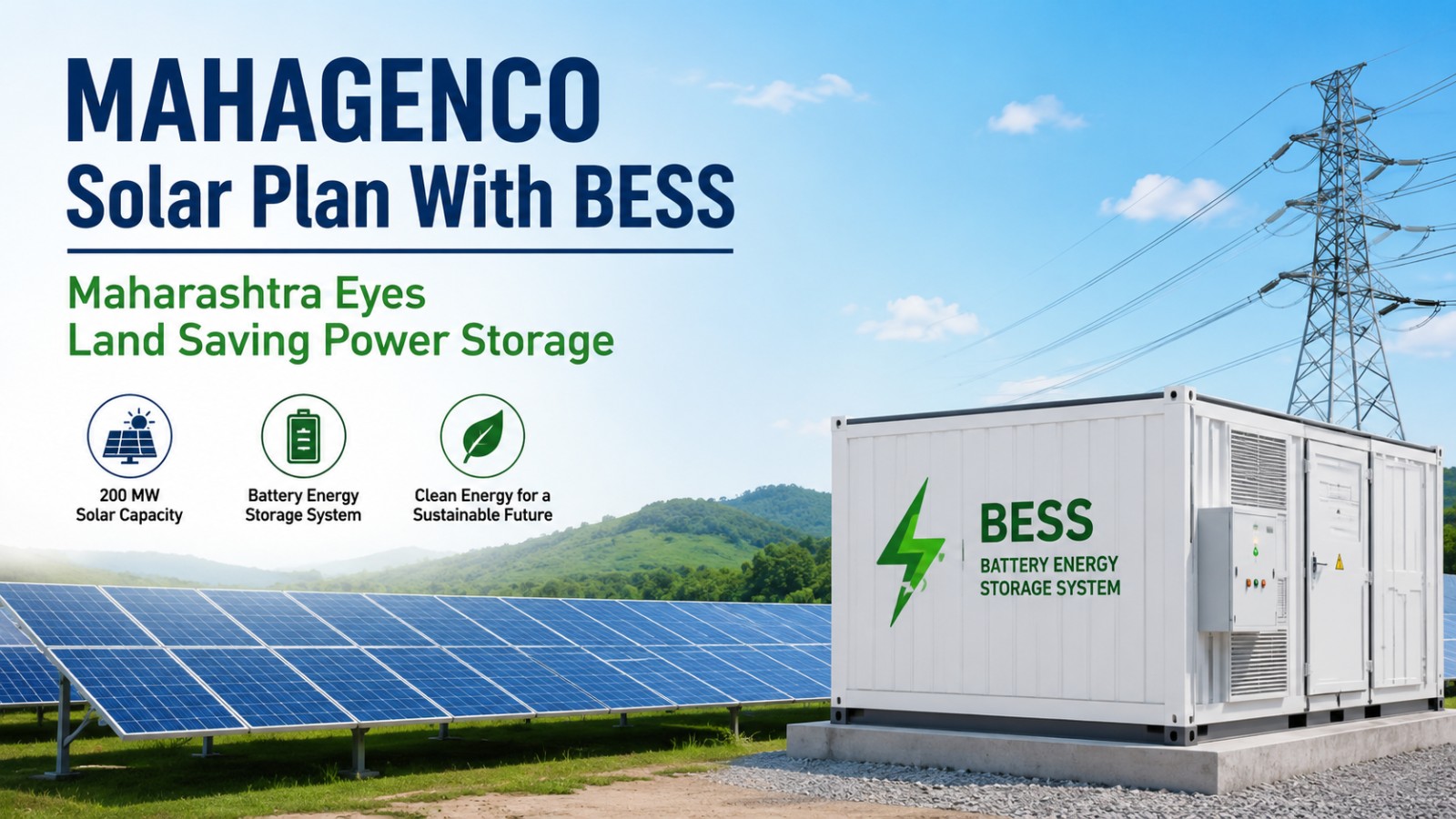
Maharashtra’s renewable energy strategy is moving towards a more integrated model where solar generation is combined with battery storage. A recent tender from Mahagenco Renewable Energy Limited, the renewable energy arm of MAHAGENCO, calls for detailed project preparation and engineering work for multiple grid connected solar projects with Battery Energy Storage Systems (BESS) across Maharashtra. The official tender specifies eight 25 MW solar projects, taking the planned solar capacity to 200 MW, along with battery storage.
The 170 MW figure associated with MAHAGENCO relates to its earlier Washim solar project, which was planned as part of a larger solar development programme. The latest solar plus storage tender is therefore best understood as a broader continuation of Maharashtra’s renewable energy expansion rather than a new 170 MW BESS project.
MAHAGENCO’s Solar Plus BESS Plan
The current tender, identified as MREL/2026-27/SOLAR HYBRID PMS/T03, was issued on May 19, 2026. It seeks professional services for preparing detailed project reports, bid specifications, engineering reviews, material inspections and project management for 8 x 25 MW grid connected solar plants along with battery energy storage systems in Maharashtra.
The pre bid clarification issued by MAHAGENCO further confirms that the development will consist of eight separate sites, each with a 25 MW solar capacity. This distributed approach is important because renewable energy projects do not always have to depend on one very large solar park. Smaller projects spread across suitable locations can make better use of available land and existing power infrastructure.
The project also reflects a wider change in the way Maharashtra is planning renewable power. Solar generation is strongest during daylight hours, while electricity demand can remain high into the evening. Adding BESS allows part of the solar power generated during the day to be stored and used later, improving the usefulness of renewable generation.
Why Battery Storage Matters for Maharashtra
Solar power has one obvious limitation: generation depends on sunlight. A solar plant can produce substantial electricity during the middle of the day, but that production falls sharply after sunset.
Battery storage changes the operating model. Instead of treating excess solar generation as power that must immediately be exported or curtailed, a BESS can store electricity and discharge it when required, subject to the project’s operating design and applicable grid regulations.
For Maharashtra, this has significance beyond renewable energy targets. The state has a large industrial and commercial electricity base, including manufacturing plants, warehouses, processing facilities and other high consumption businesses. Many of these facilities have demand profiles that do not perfectly match solar generation.
A solar and storage combination can therefore improve energy utilisation by shifting some renewable electricity from the generation period to a later demand period.
The Land Saving Angle
Land availability is becoming an increasingly important issue for large scale solar development. Ground mounted solar plants require significant areas, and acquiring contiguous parcels can involve land costs, transmission planning, environmental considerations and long development timelines.
A distributed project structure can help reduce some of these constraints. MAHAGENCO’s tender for eight separate 25 MW locations indicates an approach based on multiple sites rather than relying entirely on one large parcel. The company has also floated tenders for land arrangements supporting solar projects elsewhere in Maharashtra, showing that land and grid access remain central parts of the state’s renewable development strategy.
Storage can strengthen this model further because the objective is no longer simply to maximise daytime solar generation. The emphasis increasingly moves towards producing, storing and delivering electricity when it has greater operational value.
What This Means for Industrial and Commercial Businesses
The development is relevant even to businesses that are not directly involved in utility scale solar projects.
Industrial and commercial consumers are increasingly looking at energy costs as an operational issue rather than simply a monthly utility expense. Electricity tariffs, demand charges, time of day consumption and power quality can all affect the total cost of running a facility.
Solar can reduce dependence on grid electricity during daylight hours. Battery storage can potentially extend the usefulness of that renewable power beyond solar production hours.
However, BESS is not automatically economical for every business. Battery capacity, charging and discharging patterns, tariff structure, load profile, battery degradation, financing cost and system lifecycle all influence the business case.
This makes proper energy assessment more important than simply installing the largest possible solar plant.
Solar Investment Is Moving Towards Smarter System Design
The latest MAHAGENCO tender comes at a time when Maharashtra’s renewable sector is expanding beyond conventional standalone solar.
The state is also examining other storage and renewable configurations. MAHAGENCO’s tender listings include work related to pumped storage projects, while Maharashtra has separately initiated plans for a floating solar and battery storage project at Veer reservoir in Satara, comprising an 11 MW floating solar plant and a 5.5 MW BESS.
This points towards a broader industry trend: solar capacity is increasingly being considered together with storage, grid integration and consumption patterns.
For businesses, the lesson is straightforward. The question is no longer only how many kilowatts of solar can fit on a roof. It is also how much electricity the facility consumes, when it consumes it, how much solar power can be used directly, and whether storage can improve the overall economics.
Why Businesses Should Not Delay Solar Planning
Waiting for electricity prices, regulations or technology costs to become perfect can also mean delaying potential savings.
Businesses with large daytime electricity consumption may already have a strong case for rooftop solar because generation and consumption occur simultaneously. Manufacturing units with multiple shifts, refrigeration facilities, commercial buildings and other operations with significant evening demand may need a more detailed solar plus storage assessment.
There is also a practical advantage to planning early. A proper solar project involves structural assessment, electrical analysis, shadow study, system sizing, approvals, procurement and installation. Larger industrial projects can require additional planning for evacuation, protection systems and integration with existing electrical infrastructure.
Rather than treating solar as a quick equipment purchase, businesses can benefit from evaluating it as a long term energy infrastructure investment.
How Fore Point Solution Can Help Businesses Evaluate Solar
For industrial, commercial and manufacturing businesses in Maharashtra, the right starting point is an assessment of actual electricity consumption rather than a generic solar quotation.
Fore Point Solution provides solar EPC solutions for businesses looking to evaluate rooftop and larger solar requirements. Companies can review their electricity bills, sanctioned load, daytime consumption, available roof or site area and operating schedule to determine an appropriate system size.
Businesses interested in assessing their solar requirements can contact Fore Point Solution to discuss suitable solar EPC solutions and understand how renewable power can fit into their existing energy strategy.
Frequently Asked Questions
Q1. Is MAHAGENCO planning a 170 MW solar project with BESS?
The latest official MAHAGENCO tender available for this solar plus storage initiative specifies 8 x 25 MW, or 200 MW of solar capacity, along with BESS. The 170 MW figure is associated with MAHAGENCO’s earlier Washim solar project.
Q2. What is BESS in a solar project?
BESS stands for Battery Energy Storage System. It stores electricity generated by the solar plant and can discharge that electricity later, depending on system design, grid requirements and operating conditions.
Q3. Why combine solar with battery storage?
Solar generation is concentrated during daylight hours. Battery storage can shift some generated electricity to periods when solar output is lower, helping improve renewable energy utilisation.
Q4. Can industrial businesses install solar with batteries?
Yes. Industrial and commercial facilities can evaluate solar and BESS based on their load profile, tariff structure, operating hours, available space and financial objectives. The correct system size should be determined through a detailed technical and financial assessment.
Q5. Does battery storage always reduce electricity costs?
Not necessarily. BESS involves additional capital and operating costs. Its financial value depends on factors such as tariff differences, demand charges, solar utilisation, battery lifecycle and the site’s consumption pattern.
Q6. Will solar plus storage reduce land requirements?
Storage itself does not replace solar panels, but combining storage with appropriately distributed solar projects can improve how renewable power is generated and delivered. MAHAGENCO’s multi site approach also reduces dependence on developing one very large solar location.
Q7. What should a Maharashtra business do before investing in solar?
Businesses should first analyse electricity bills, sanctioned load, peak demand, operating hours, daytime consumption, available installation area and future electricity requirements. A technical feasibility and financial assessment can then determine whether rooftop solar, ground mounted solar, storage or a combination is appropriate.


