



Rooftop Solar Subsidy: New Eligibility Rules for ₹78,000 Central Assistance Explained

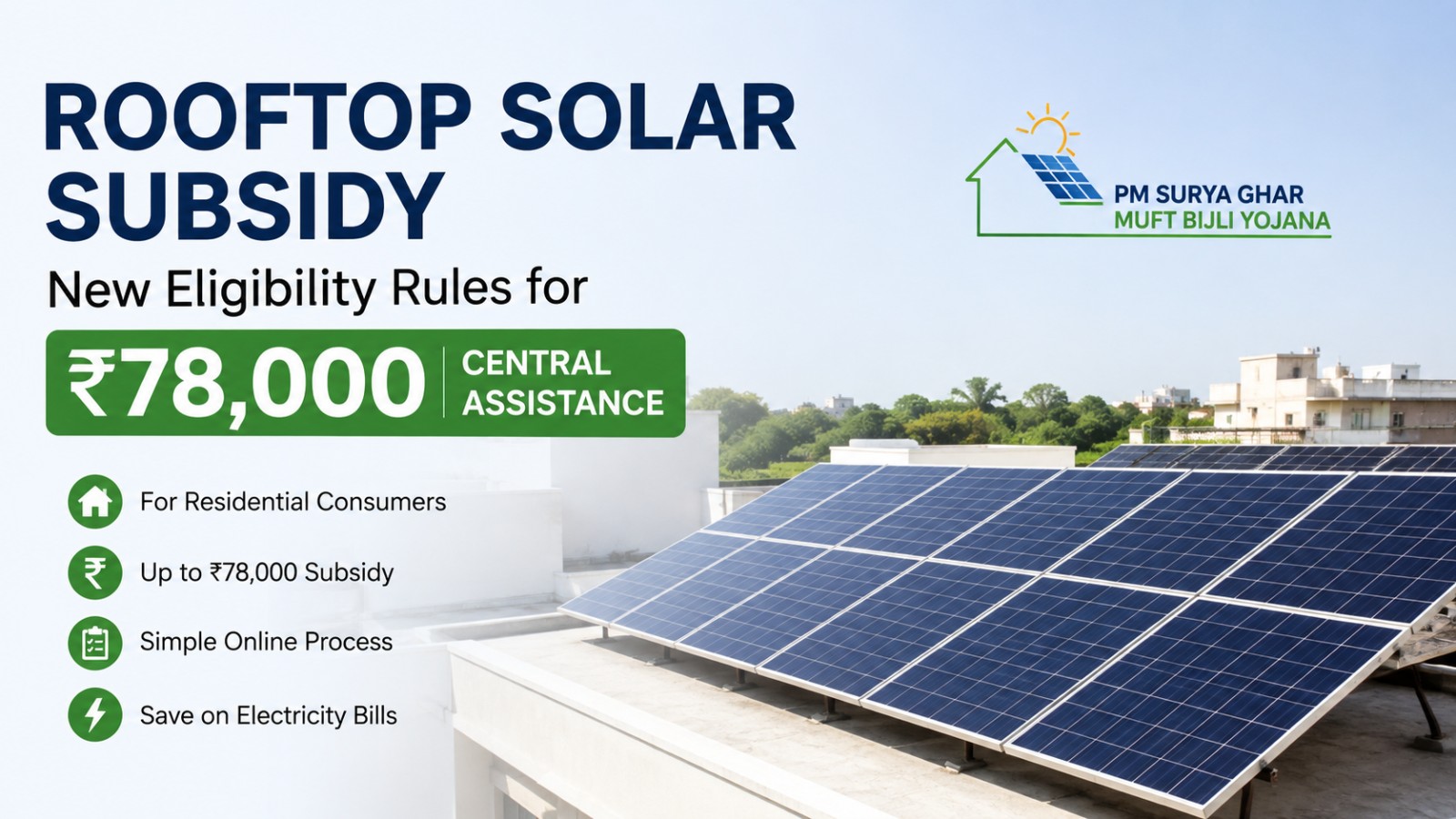
India’s rooftop solar push is continuing to gain momentum, but for households planning an installation, understanding the subsidy rules is just as important as choosing the right solar system. Under the PM Surya Ghar: Muft Bijli Yojana, eligible residential consumers can receive Central Financial Assistance of up to ₹78,000 for rooftop solar.
However, the ₹78,000 figure does not mean every solar installation automatically qualifies for the maximum amount. The assistance depends on system capacity, the type of electricity connection, compliance with scheme requirements and the installation and verification process followed through the concerned distribution company.
The Ministry of New and Renewable Energy (MNRE) has also issued amendments and clarifications to the scheme guidelines. The latest framework continues to focus the central subsidy on the residential sector, while making the process for state level support more closely connected with the National Portal.
What Is the ₹78,000 Rooftop Solar Subsidy?
The PM Surya Ghar scheme provides Central Financial Assistance for eligible grid connected residential rooftop solar systems.
The current central subsidy structure is:
| Rooftop Solar Capacity | Central Financial Assistance |
|---|---|
| Up to 1 kW | ₹30,000 |
| Up to 2 kW | ₹60,000 |
| Up to 3 kW | ₹78,000 |
| Above 3 kW | Maximum ₹78,000 |
The first 2 kW attracts assistance of ₹30,000 per kW. An additional ₹18,000 is available for the third kilowatt, taking the maximum central assistance to ₹78,000. Installing a system larger than 3 kW does not increase the central subsidy beyond this limit.
This distinction is important for consumers comparing system sizes. A household may need 4 kW, 5 kW or more based on its electricity consumption, but the central assistance remains capped at ₹78,000.
Who Is Eligible for the Rooftop Solar Subsidy?
One of the most important points is that PM Surya Ghar is primarily a residential rooftop solar subsidy scheme.
According to government information, residential consumers with a valid grid connected electricity connection of the local DISCOM can apply through the National Portal. The scheme is designed for households installing rooftop solar on a suitable residential property.
Applicants should broadly meet the following conditions:
- The applicant should be an Indian citizen.
- The property should have a suitable roof or eligible structure for rooftop solar installation.
- The household should have a valid electricity connection.
- The solar installation should be connected to the electricity grid and comply with the applicable scheme requirements.
- The applicant should not have already received a subsidy for the same rooftop solar installation under another applicable government programme.
- The installation and documentation must satisfy the requirements of the concerned DISCOM and the PM Surya Ghar process.
The subsidy is not simply deducted from the quoted installation price. The process involves application, vendor selection, installation, inspection and verification before the eligible CFA is released. MNRE states that the consumer pays the balance amount after accounting for the subsidy/CFA process following successful installation and verification.
What Changed in the New Eligibility Framework?
The central subsidy amount itself has not been increased beyond ₹78,000. The more significant changes have been around implementation and coordination.
In July 2025, MNRE issued an amendment to the guidelines concerning Central Financial Assistance to residential consumers. One notable clarification concerns additional subsidies offered by State or Union Territory governments.
States and UTs can supplement the central assistance for eligible residential rooftop solar installations, subject to the scheme’s conditions. The amendment strengthened the requirement that the state subsidy process be integrated with the National Portal.
For consumers, this means it is increasingly important to rely on the official portal and the applicable state and DISCOM procedures rather than assuming that a subsidy advertised by an installer or third party will automatically be available.
Why the ₹78,000 Cap Matters When Choosing System Capacity
The subsidy should not be the only factor used to determine solar capacity.
For example, a household with high electricity consumption may find that a 4 kW or 5 kW rooftop system provides better long term savings than limiting the installation to 3 kW simply because ₹78,000 is the maximum central assistance.
The subsidy is capped, but electricity generation is not. A properly designed larger system can generate more solar power and offset a greater portion of annual electricity consumption, subject to applicable DISCOM and regulatory rules.
This is why consumers should first evaluate their electricity bills, daytime consumption, available roof area and future electricity requirements. The subsidy should then be considered as one part of the overall investment calculation.
What Does This Mean for Businesses in Maharashtra?
For industrial, commercial and manufacturing businesses, there is an important distinction.
The ₹78,000 PM Surya Ghar residential subsidy should not be treated as a subsidy for commercial or industrial rooftop solar installations. A manufacturing unit, commercial establishment or industrial facility with a commercial electricity connection should evaluate its solar project under the applicable commercial, industrial, captive, open access or other relevant regulatory framework rather than assuming residential CFA eligibility.
That does not make rooftop solar less attractive for businesses.
In fact, businesses with substantial daytime electricity consumption can have a strong economic case for rooftop solar because solar generation can directly offset purchased grid electricity during operating hours. A manufacturing facility with large machinery loads, for example, may be able to reduce its daytime grid requirement through a properly engineered rooftop system.
The financial benefit depends on the tariff structure, sanctioned load, consumption profile, solar generation, system size, financing cost, applicable regulations and the availability of suitable rooftop space.
For Maharashtra businesses, the right approach is therefore not to chase a ₹78,000 subsidy. It is to calculate the actual energy savings and project economics before investing.
Rising Solar Adoption Is Changing the Business Energy Equation
The growth of rooftop solar is also changing how businesses approach electricity costs.
Government data released in February 2026 showed that more than 26 lakh households had benefited under PM Surya Ghar by December 2025, with more than ₹14,771 crore in central financial assistance disbursed. The scheme remains demand driven and is intended to support rooftop solar adoption at a national scale.
For businesses, this wider adoption matters because solar is increasingly becoming an energy cost management tool rather than simply an environmental initiative.
Manufacturers and commercial property owners face recurring electricity expenses. A rooftop solar plant can convert part of that recurring operating expenditure into an investment in an electricity generating asset. Over its operating life, the plant can potentially reduce exposure to rising grid electricity costs, subject to actual tariff and generation conditions.
Why Delaying a Solar Assessment Can Be Costly
There is no need to rush into an installation simply because a subsidy is available. But there is also little benefit in postponing a feasibility assessment indefinitely.
Electricity bills continue every month while an unused rooftop remains an unused energy asset. For businesses, delaying a project also means delaying potential savings and the opportunity to understand how much of the facility’s electricity requirement can realistically be supplied through solar.
Residential consumers should similarly check their eligibility, documentation, roof condition and DISCOM requirements before selecting a vendor. Choosing a non compliant system or misunderstanding the subsidy structure can create unnecessary complications during the claim process.
The practical first step is therefore an assessment, not an immediate purchase.
How to Apply for PM Surya Ghar Subsidy
Eligible residential consumers can use the official PM Surya Ghar National Portal to begin the application process. The portal provides information related to rooftop solar applications, vendors and scheme procedures.
The process generally involves registering the electricity connection, applying through the portal, selecting an eligible vendor, obtaining the required approvals, installing the rooftop system and completing DISCOM inspection and verification.
Consumers should keep their electricity connection details and required personal and banking information accurate throughout the process. Errors in consumer details or documentation can delay the subsidy process.
What Maharashtra Businesses Should Do Next
For homeowners, the immediate question is whether their property and electricity connection qualify for the residential subsidy.
For Maharashtra’s industrial, commercial and manufacturing sector, the question is different: How much can rooftop solar reduce the company’s annual electricity expenditure?
A proper feasibility study should consider roof area, electricity consumption, load profile, sanctioned load, system capacity, expected generation, electrical infrastructure, financing and applicable regulations.
Fore Point Solution can help businesses assess their rooftop solar requirements and understand suitable solar EPC solutions for their facility. Instead of choosing a system based only on subsidy claims, businesses can evaluate the project around actual electricity consumption, expected generation and long term savings.
For companies already considering rooftop solar, getting the assessment done early can help identify structural, electrical or approval requirements before they become project delays.
Frequently Asked Questions
Q1. Is ₹78,000 available for every rooftop solar installation?
No, ₹78,000 is the maximum central assistance under the residential PM Surya Ghar structure. The amount is calculated according to eligible capacity, with ₹30,000 per kW for the first 2 kW and ₹18,000 for the third kW. Systems above 3 kW remain capped at ₹78,000.
Q2. Can commercial businesses claim the ₹78,000 PM Surya Ghar subsidy?
The PM Surya Ghar CFA component discussed here is intended for eligible residential consumers. Commercial and industrial consumers should not assume that their business rooftop system qualifies for the residential subsidy.
Q3. Does installing a 5 kW system provide more than ₹78,000 central subsidy?
No, The central assistance is capped at ₹78,000 once the eligible capacity reaches 3 kW. A larger system may still make financial sense if the consumer needs additional generation.
Q4. Is the subsidy paid before solar installation?
The subsidy process is linked to installation, inspection and verification. It should not be treated as an upfront cash discount from the installer.
Q5. Can a state government provide additional solar subsidy?
Yes, State or UT governments may supplement central assistance for eligible residential rooftop solar projects, subject to the applicable framework. The amended guidelines provide for integration of the state subsidy disbursement process with the National Portal.
Q6. Should businesses in Maharashtra wait for a rooftop solar subsidy?
Businesses should not base the entire investment decision on the residential ₹78,000 subsidy. Commercial and industrial projects should instead be evaluated on electricity consumption, tariff, generation potential, project cost, financing and applicable regulations.
Q7. What is the first step before installing rooftop solar?
Start with a technical and financial assessment. Reviewing electricity bills, roof area, daytime consumption and existing electrical infrastructure can help determine the appropriate system size and expected savings before finalising an EPC solution.


