


Maharashtra Industries Hit by ₹1.42/Unit Grid Support Charge on Rooftop Solar Above 10 kW

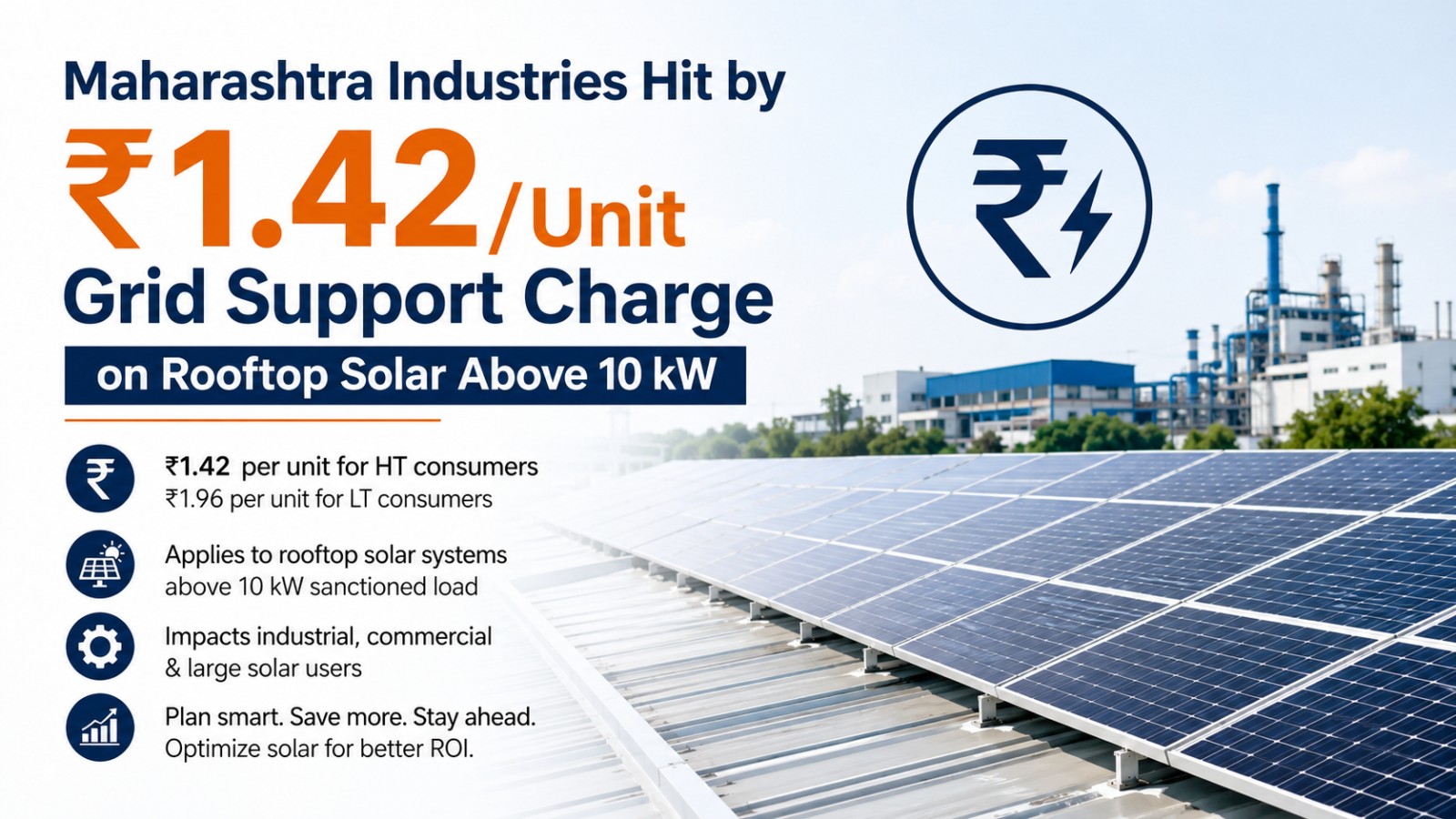
Maharashtra’s rooftop solar market has entered a new phase, with larger solar users now having to account for a Grid Support Charge while calculating their electricity savings. From April 1, 2026, the Maharashtra Electricity Regulatory Commission (MERC) framework provides for a Grid Support Charge of ₹1.42 per unit for high tension (HT) consumers and ₹1.96 per unit for low tension (LT) consumers with rooftop solar systems and sanctioned loads above 10 kW. The rates form part of MERC’s approved five year tariff calculations.
For industrial units, factories, warehouses, commercial buildings and other businesses in Maharashtra, the change does not mean rooftop solar has suddenly become uneconomical. However, it does mean that businesses need to evaluate solar projects more carefully, particularly where a significant share of generated electricity is exported to the grid rather than consumed directly at the premises.
What Is the New Grid Support Charge?
The Grid Support Charge is a regulatory charge associated with the use and support of the electricity distribution system by eligible rooftop solar consumers. MERC’s calculations take into account factors such as balancing costs, wheeling charges, distribution losses and the benefits associated with rooftop renewable energy.
The important point for businesses is the eligibility threshold. The charge applies to rooftop solar consumers with a sanctioned load above 10 kW under the applicable framework. MSEDCL has clarified that it does not apply universally to every rooftop solar consumer in Maharashtra.
For FY 2026 27, the approved GSC is ₹1.42 per unit for HT consumers and ₹1.96 per unit for LT consumers. The MERC order also provides a future rate trajectory, with the HT charge listed at ₹1.38 in FY 2027 28 and ₹1.55 in FY 2028 29, while the LT charge is ₹1.93 and ₹2.10 respectively for those years.
This makes the charge an important line item when businesses prepare a long term solar ROI calculation.
Why Are Industrial and Commercial Users Paying Attention?
The impact is more significant for businesses because their electricity consumption is substantially higher than that of an average household.
A manufacturing facility may operate multiple motors, compressors, pumps, HVAC systems, production lines and other machinery throughout the day. Commercial establishments can have substantial loads from air conditioning, refrigeration, lighting, lifts and equipment.
A rooftop solar plant can reduce the amount of electricity purchased from the distribution company, but the financial outcome depends on how much of the solar generation is actually used and how much is exported or adjusted through the applicable billing mechanism.
The new charge therefore changes the calculation.
For example, a business generating 50,000 units of solar electricity in a period, if the applicable GSC is calculated on that generation, would have a gross GSC exposure of approximately ₹71,000 at ₹1.42 per unit. The actual bill impact depends on the consumer category, applicable regulations and billing treatment, so businesses should not use this figure as a universal payable amount.
That distinction is important. The charge should be considered alongside the savings generated by solar, not viewed in isolation.
Solar Still Offers a Major Cost Saving Opportunity
Despite the additional charge, rooftop solar remains relevant for Maharashtra businesses because electricity costs represent a recurring operating expense.
Solar can reduce dependence on grid electricity during daylight hours, particularly when the facility’s production schedule matches solar generation. A well designed system can therefore deliver significant savings over its operating life.
The business case becomes stronger when solar is designed around actual consumption rather than simply installing the largest possible system.
For an industrial unit, for example, engineers can examine historical electricity bills, sanctioned load, maximum demand, daytime consumption, roof area, generation potential and operating schedules before recommending system capacity.
This approach can help businesses avoid oversizing the plant and exporting unnecessary energy.
The Bigger Change: Solar Planning Is Becoming More Technical
Maharashtra’s latest tariff framework also highlights a broader shift in the rooftop solar market.
Earlier, many businesses primarily asked a simple question: How many kilowatts of solar can we install?
The more relevant question now is: How much solar energy can our business consume at the right time?
That difference matters.
A factory operating heavily during solar hours may be able to use a large percentage of its generation directly. A business whose electricity demand rises mainly during evening hours may have a different economic profile.
This is where load analysis, system sizing, energy management and, where appropriate, storage solutions can become important.
Battery Energy Storage Systems can potentially help businesses shift some solar energy from periods of high solar generation to periods when electricity demand is higher. However, battery storage involves additional capital expenditure, so it should be evaluated based on the site’s load profile and tariff structure rather than added automatically.
What Does This Mean for Existing Solar Users?
Businesses that already have rooftop solar should not assume that their entire investment has become unviable.
Instead, they should review their electricity bills and solar generation data.
The key questions include:
- What is the installed solar capacity?
- What is the sanctioned load?
- Is the connection LT or HT?
- How many units does the plant generate every month?
- How much solar power is consumed directly?
- How much is exported or carried forward?
- What Grid Support Charge is appearing on the bill?
- How have the revised billing arrangements affected monthly savings?
A proper review can show whether operational changes, load shifting, additional storage or other energy management measures could improve the project’s economics.
MSEDCL has stated that only a small proportion of consumers fall within the GSC category. According to figures reported in May 2026, 44,246 consumers across categories were covered, representing about 0.14% of the state’s total consumer base. The industrial segment had around 8,894 affected consumers, while the commercial segment had around 12,832.
What Should Businesses Planning Solar Do Now?
For companies that have been considering rooftop solar but have delayed the decision, the latest rules make proper project planning more important, not necessarily a reason to abandon solar.
Businesses should obtain a project assessment based on their current electricity consumption rather than relying on a generic per kW savings estimate.
An EPC assessment should ideally consider the last 12 months of electricity bills, sanctioned load, maximum demand, tariff category, daytime consumption, roof condition, shadow analysis and expected solar generation.
For larger facilities, the analysis should also consider whether a combination of rooftop solar, energy storage and load management can improve self consumption.
This is particularly relevant for Maharashtra’s manufacturing and MSME sector, where electricity costs can directly influence production economics.
Why Delaying the Decision Can Cost Businesses
The strongest reason to act is not fear of the new charge. It is the cost of continuing to purchase all electricity from the grid without examining available alternatives.
Every month a business postpones a properly assessed solar project, it continues to carry its existing electricity expenditure. At the same time, tariff structures, grid charges, banking provisions and renewable energy regulations can change over time.
That makes a current engineering and financial assessment more valuable than waiting for a supposedly perfect policy environment.
Businesses that evaluate their electricity profile early can also compare different system sizes and understand whether maximum rooftop capacity or higher self consumption provides the better return.
Fore Point Solution Can Help Businesses Assess the Right Solar Approach
For industrial, commercial and manufacturing businesses in Maharashtra, rooftop solar should be treated as an energy investment rather than simply a panel installation.
Fore Point Solution can help businesses assess their electricity consumption, rooftop potential and solar requirements before moving ahead with an EPC solution. Instead of relying only on system size, businesses can evaluate the relationship between generation, consumption, grid dependence and expected savings.
If your factory, warehouse, office, commercial property or manufacturing unit is considering solar, now is a good time to review the numbers under the current Maharashtra regulatory environment.
Visit Fore Point Solution to assess your solar requirements and enquire about a suitable rooftop solar EPC solution for your business.
Frequently Asked Questions
Q1. Does the ₹1.42 per unit Grid Support Charge apply to every solar user in Maharashtra?
No. The ₹1.42 per unit rate applies to eligible HT consumers under the current FY 2026 27 framework. The charge is associated with rooftop solar consumers having sanctioned loads above 10 kW. LT consumers have a separate FY 2026 27 rate of ₹1.96 per unit.
Q2. Does the Grid Support Charge mean rooftop solar is no longer profitable?
Not necessarily. Solar savings depend on electricity tariffs, generation, self consumption, system cost, financing and applicable charges. A properly sized system can still reduce grid electricity purchases substantially.
Q3. Which businesses should be particularly concerned about the change?
Industrial plants, manufacturing units, warehouses, commercial properties and other larger consumers with sanctioned loads above 10 kW should specifically review the impact because their solar generation and electricity consumption can be substantial.
Q4. Is the charge the same for LT and HT consumers?
No, For FY 2026 27, MERC’s approved calculation lists ₹1.42 per unit for HT consumers and ₹1.96 per unit for LT consumers.
Q5. Should businesses stop installing rooftop solar because of the charge?
Businesses should not make that decision based on the charge alone. They should calculate the complete project economics, including solar generation, direct consumption, applicable grid charges, tariff savings, financing and maintenance costs.
Q6. Can battery storage help businesses manage the impact?
Potentially. Storage can help shift solar energy to periods when the business needs electricity, but its financial benefit depends on the site’s load profile, tariff structure, battery cost and operating pattern. A technical feasibility study should come first.
Q7. What should a business check before installing a solar system above 10 kW?
Review the last 12 months of electricity bills, sanctioned load, connection type, maximum demand, daytime consumption, rooftop area, expected generation and applicable billing regulations. A detailed EPC assessment can then determine an appropriate system size and configuration.


