



Subsidies for Individual Flat Owners in Housing Societies: Government Schemes & Benefits in Maharashtra

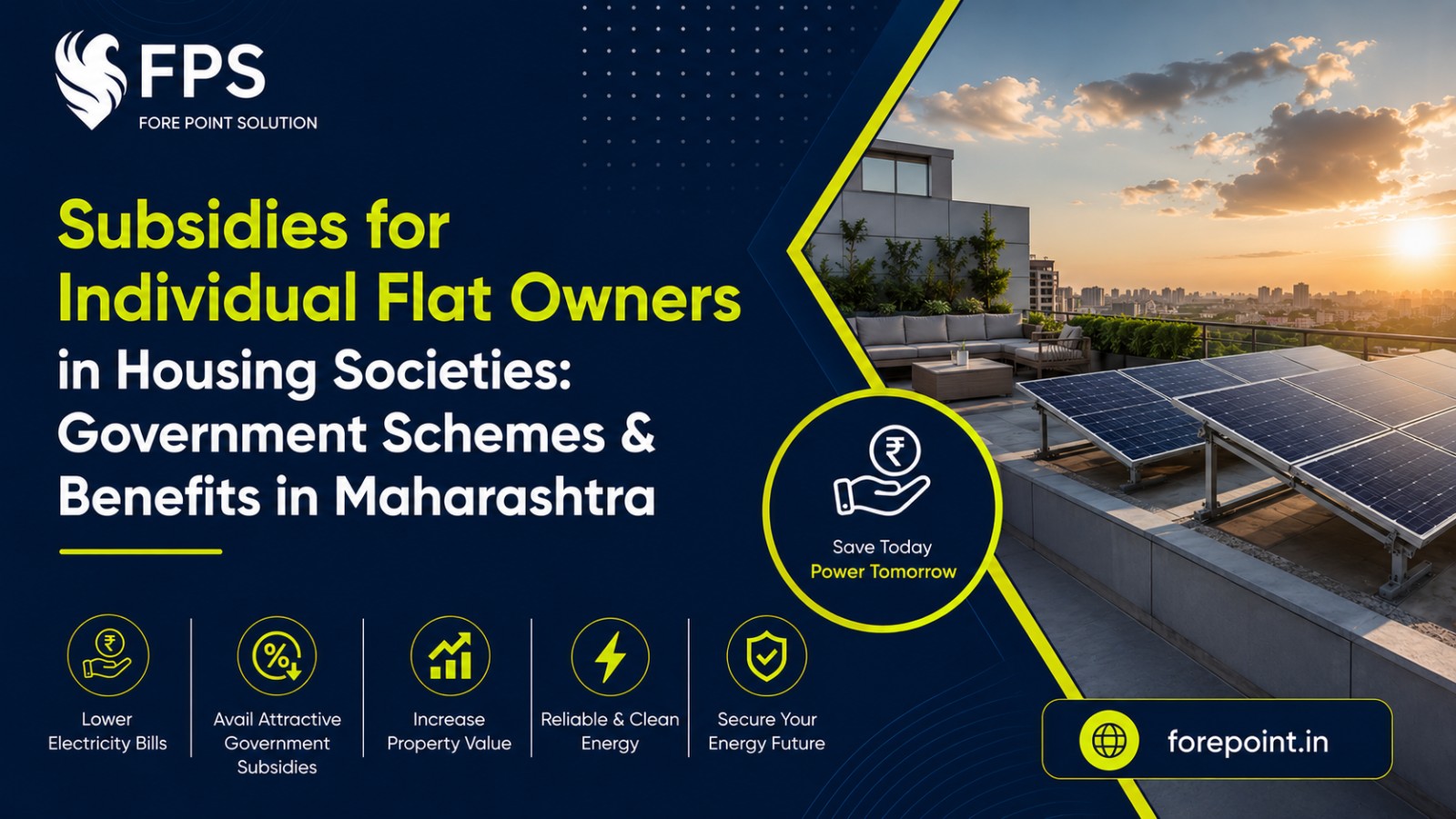
For many flat owners in Maharashtra, electricity bills are a regular household expense. This is especially true for families using air conditioners, water heaters, refrigerators, washing machines and other appliances. With rooftop solar becoming more accessible, individual flat owners living in housing societies are also looking at government support that can reduce the initial cost of installation.
The topic of subsidies for individual flat owners in housing societies is important because a society rooftop and an individual flat owner’s rooftop solar system are not always treated in the same way. Government support can depend on the consumer category, electricity connection, system capacity and applicable scheme conditions.
For homeowners considering rooftop solar in 2026, understanding the available government schemes, eligibility and installation process can help avoid confusion before making an investment.
Can Individual Flat Owners Get Solar Subsidy?
Yes, eligible residential electricity consumers may receive financial assistance under applicable government rooftop solar programmes. However, owning a flat in a housing society does not automatically mean that every resident receives a subsidy.
The individual flat owner generally needs to have an eligible residential electricity connection and meet the requirements of the applicable scheme. The rooftop solar system also needs to satisfy the required technical and installation conditions.
This distinction is important because a society may install a solar system for common facilities such as lifts, water pumps and common lighting, while an individual resident may install a separate system for their own electricity consumption.
Therefore, homeowners should first establish whether they are applying as an individual residential consumer or through the housing society.
Government Subsidies for Flat Owners in Maharashtra
The government subsidies for flat owners in Maharashtra can make residential rooftop solar more affordable for eligible households. Under the PM Surya Ghar programme, Central Financial Assistance is available to eligible residential consumers according to the applicable capacity and scheme guidelines.
The commonly stated residential subsidy structure is:
| Rooftop Solar Capacity | Subsidy |
|---|---|
| Up to 2 kW | ₹30,000 per kW |
| Additional capacity up to 3 kW | ₹18,000 per kW |
| Above 3 kW | Maximum total subsidy of ₹78,000 |
The actual amount available to a particular homeowner depends on eligibility and the current scheme requirements.
A flat owner should not calculate the final project cost simply by subtracting the maximum subsidy from an installation quotation. The applicable benefit depends on the approved system and current government rules.
Before making payment, verify the latest subsidy guidelines and application requirements.
How Does Solar Work for a Flat in a Housing Society?
The biggest practical issue for flat owners is rooftop access. In an apartment building, the terrace is generally a shared area rather than an individual flat owner’s private roof.
This means an individual flat owner may need permission or coordination with the housing society before installing a private rooftop solar system, depending on the building structure and available installation arrangement.
Some societies may have enough rooftop space for individual systems, while others may prefer a common solar plant serving multiple residents or common facilities.
The electrical arrangement also matters. The proposed solar system must be connected appropriately to the eligible electricity connection and comply with applicable requirements.
A solar installer should inspect the property and explain whether an individual rooftop installation is practical.
What Are the Benefits for Individual Flat Owners?
The main benefit is the possibility of reducing electricity purchased from the grid. A properly sized rooftop solar system can generate electricity during daylight hours and offset a portion of household consumption.
The subsidy can reduce the initial investment for eligible households. Over the longer term, electricity savings can contribute towards recovering the remaining installation cost.
Solar can also help homeowners make productive use of suitable rooftop space rather than leaving it unused.
However, the actual savings vary from home to home. Electricity consumption, system capacity, sunlight, shading, tariff and system performance all influence the financial outcome.
Homeowners should therefore request a property specific generation and savings estimate rather than relying on a standard savings claim.
Government Schemes for Flat Owners
The most important step is identifying which government schemes for flat owners apply to the individual residential electricity connection.
A homeowner should verify the scheme’s eligibility criteria, required documents, approved system specifications and application process before installation.
Do not rely only on information provided verbally by an installer. Government programmes can have specific requirements regarding consumer category, equipment and installation procedures.
Keep copies of your electricity bill, identity documents, application details, installation invoice and other relevant records.
If a solar company is handling the application process, ask the company to explain exactly what it will manage and what documents the homeowner needs to provide.
Housing Society Subsidies in Maharashtra
There is an important difference between individual residential subsidies and housing society subsidies in Maharashtra.
A housing society or RWA may consider a solar project for common facilities. Electricity used by lifts, water pumps, common lighting, security systems and other shared services can form a substantial part of society maintenance expenses.
Such a project is separate from an individual flat owner’s residential rooftop solar installation.
A society should therefore decide whether its objective is to reduce common electricity expenses, support individual residents, or consider both options.
In either case, the project should begin with an assessment of electricity consumption, rooftop availability and the applicable government provisions.
How to Apply for Solar Subsidy
For an individual homeowner, the process generally starts with checking the electricity connection and scheme eligibility. The next steps involve selecting an appropriate rooftop solar system and an eligible installation route under the applicable programme.
A site survey should then assess available rooftop space, shading, roof condition and electrical requirements.
The installer can assist with system design, quotation and applicable documentation. After installation, the required inspection, metering or grid related procedures may apply depending on the connection and scheme.
Homeowners should retain all application and installation documents until the subsidy process is completed.
The exact procedure can change, so verify the current process before submitting an application.
Solar Panel Installation Services in Palghar
Flat owners and housing societies in Palghar looking for Solar Panel Installation Services in Palghar should compare companies based on technical experience, equipment quality and support rather than selecting an installer only because of a low price.
The installer should first understand your electricity consumption and rooftop situation. A proper quotation should clearly mention the panel specifications, inverter, mounting structure, electrical protection, installation work, warranty and documentation support.
For apartment buildings, the installer should also explain how the rooftop space and electrical connection will be handled.
Choose Fore Point Solution
If you are a flat owner or housing society planning rooftop solar, Fore Point Solution can help you understand the installation requirements and evaluate a suitable system for your property.
For customers in Palghar and nearby areas, the process can begin with a site assessment, electricity consumption review and discussion about available rooftop space. The team can also guide customers through applicable installation and documentation requirements.
Whether you are considering an individual residential system or a larger society solar project, proper planning is important before making the investment.
Planning rooftop solar for your flat or housing society? Contact Fore Point Solution to discuss your electricity usage, rooftop space and suitable solar installation options.
Conclusion
Understanding subsidies for individual flat owners in housing societies is important before investing in rooftop solar. The availability and amount of government assistance depend on eligibility, residential consumer status, system capacity and current scheme requirements.
Flat owners should also remember that rooftop access and electrical connection arrangements can be different in apartment buildings compared with independent homes.
Before choosing a solar system, review your electricity bills, discuss rooftop access with your housing society and obtain a detailed quotation from an experienced installer.
Most importantly, verify the latest government subsidy rules before calculating your final investment. A properly designed system, professional installation and clear documentation can make the transition to rooftop solar much easier.
Ready to Reduce Your Electricity Bills with Solar?
Find out how much you can save before future policy changes and rising demand increase costs. Get expert guidance on the right solar system and available subsidy benefits.
Frequently Asked Questions
Q1. Can individual flat owners get solar subsidies in Maharashtra?
Eligible residential electricity consumers may receive applicable rooftop solar financial assistance, subject to current government scheme conditions, system requirements and consumer eligibility.
Q2. What are the subsidies for individual flat owners in housing societies?
The applicable residential subsidy can be based on the installed rooftop solar capacity. The commonly stated structure is ₹30,000 per kW up to 2 kW and ₹18,000 per kW for additional capacity up to 3 kW, with the total subsidy capped at ₹78,000 for systems above 3 kW.
Q3. Can a flat owner install solar panels on a society rooftop?
It depends on the building’s rooftop arrangement, available space, society permissions and electrical connection. The homeowner should discuss the installation with the housing society before proceeding.
Q4. Are housing society solar subsidies different from individual subsidies?
Yes. A solar project for common society facilities can fall under different provisions from an individual residential rooftop system. The applicable benefit depends on the consumer category and current government guidelines.
Q5. What documents may be required for solar subsidy?
Documents can include the electricity bill, identity and consumer details, installation documents and other information required under the applicable scheme. The exact requirements should be verified during application.
Q6. How do I choose Solar Panel Installation Services in Palghar?
Compare installers based on site assessment, system design, equipment quality, warranty, installation experience, documentation support and after sales service. Avoid choosing solely on the lowest quotation.
Q7. Can solar reduce a flat owner’s electricity bill?
Yes, a properly sized rooftop solar system can reduce electricity purchased from the grid. Actual savings depend on household consumption, system capacity, sunlight, shading, tariff and system performance.


